The Independently Wealthy – April 2026 End of Month Update

Old Man with a Gold Chain (1631) – Rembrandt van Rijn – Art institute Chicago

In his youth, it was a revelation to Slack Investor that some people didn’t have a job – they just had income derived from assets.

He didn’t know of anyone who was independently wealthy, and thought that the normal course was to work hard till retirement age, then apply for the government pension. That’s what his parents and grandparents did. Those who have been employed since compulsory super emerged in the 1990’s can rely on industry-based super plus any extra savings.

Slack Investor has had the aim of being independently wealthy – being able to support retirement through income from assets (investments). This is the goal. However, things happen along the way, and the next best thing would be to own your own (even modest) home before retirement and get to the ‘sweetspot’ of assets. As of March 2026, this is where a couple can have between $470 000 and $1 045 500 in retirement assets and still qualify for some government-funded aged pension to top up their income from savings.

The Path to Independent Wealth

It was reading the pioneer finance blogs of people like Mr Money Moustache that the idea of ‘Independent Wealth’ could be pursued by a normal working person. First, you have to save your retirement funds. Hopefully, the fund return will be a few percent above inflation and then you can withdraw money (based loosely on the ‘4% rule’) to live on.

‘Assuming a minimum requirement of 30 years of
portfolio longevity, a first-year withdrawal of 4%,
followed by inflation-adjusted withdrawals in
subsequent years, should be safe.– FPA Journal – The Best of 25 Years: Determining Withdrawal Rates Using Historical Data

Maximum safe withdrawal rate (SAFEMAX) calculated for a 30-yr retirement on a conservative balanced portfolio of 50% US stocks and 50% US Bonds. From – Determining Withdrawal Rates Using Historical Data by William P. Bengen

There is some concern that this ‘4% rule’ of thumb is inadequate as it is based upon historical market performance from 1926 until 1992 where stock market returns have been mostly good. Some advisers recommend a lower withdrawal rate of 3.3% in the initial stages – and a flexible approach to retirement spending.

The Independent Wealth Path Could be Tricky in the Next Decade

Due to the current high valuations, Vanguard is predicting a lower than average median 10-yr return for equities for the next 10 years. The Vanguard predictions are based upon past data and do not account for the productivity benefits of AI – which might justify current valuations – but they are a concern.

Vanguard 10-year annualised nominal return (In Australian Dollars) and volatility forecasts are based on the 31 December 2025 run of the Vanguard Capital Markets Model (VCMM) The model incorporates the long-term predictive power of current CAPE valuations.

Slack Investor’s view is that no one really can predict the future, and there is a high volatility expressed with these equity forecasts. However, the Vanguard model 10-yr forecasts have usually been correct between the 25th and 75th percentile ranges. This gives a more rubbery forecast that Slack Investor is happier to work with. From the Vanguard Capital Markets Model forecasts issued April 2026, the predicted 10-yr percentile annual returns for each asset group are shown below. Median predictions for 10-yr earnings in stocks are the lowest since this prediction model was developed. When compared to historical returns over the past 30 years (Vanguard), the median forecasts are quite low for stock-related investments.

Asset Class25th Percentile ForecastMedian Forecast75th Percentile ForecastVanguard Historical 30-yr av. Returns
US Equities2.6%5.9%9.6%10.1%
Global (ex US) Equities3.1%6.0%9.1%9.6%
Emerging Markets0.5%4.6%8.7%9.9%
US Treasury bonds4.0%4.6%5.3%4.1%
US Inflation1.4%2.0%2.5%2.6%

Vanguard model predicted 10-yr (From 2026) percentile and median annual returns for each asset group. The historical average for the previous 30-yr is also shown.

The ‘Independent Wealth’ path could be tricky to negotiate in the next 10 years if the forecast 10-yr returns are nearer the 25th percentile – there is a 25% chance that the returns will be lower than this. The best way to protect your funds is to hold a good portion of them in stable reserve. Slack Investor has about 30% of his funds in annuities, cash/bonds, stable dividend stocks, REIT’s, etc. Also, keep your retirement portfolio diversified across asset classes.

What Slack Investor did with the ‘4% Rule’

Before retirement: He used the ‘4% rule’ of thumb to determine the equivalence of salary and income, so that he knew if he had enough funds to retire.

For example, if a retirement salary of $40 000 for a couple is required, the 4% rule indicates that we should multiply this amount by 25 to get our retirement lump sum.

$40 000 x 25 = $1 000 000 in retirement funds

$80 000 x 25 = $2 000 000 in retirement funds, etc

First 5 years of retirement: Be careful here, this is where you are most prone to sequencing risk.

Sequencing risk (also called sequence of returns risk) is the danger that a significant market downturn in the early years of retirement will permanently damage your portfolio – Wealthlab

Slack Investor encountered below average returns in his 2nd and 4th year of retirement. He coped with this in two ways.

1. A dynamic spending strategy approach to net withdrawals from the retirement fund. After a good year, we would spend more on holidays. A bad year would mean a more modest approach.

2. The use of pile theory (buckets). His initial spread was 70% in investments and 30% in stable income. He has tried to keep these ratios reasonably steady by withdrawing from the over allocated pile each year.

Set up a ratio of Stable income: Investments in Your Retirement Fund that you are happy with and take your annual expenses out of the pile that is over allocated at the end of the year. In the above case, Investments – From Slack Investor

After 5 years of retirement: Fill your boots. If the first 5 years hasn’t stressed your retirement funds, then things should be fine. There are mandated withdrawals from Super Funds (Aged 65–74:  5%, 75–79:  6%, 80–84:  7%, etc) but, if you are under age 75, re-contribution of any excess funds is a good idea.

Slack Investor has gone down the path of trying to preserve most of the capital in his retirement fund to use as a gift to the next generation or, (I hope not!) an aged care accommodation deposit. He won’t mind a bit of capital shrinkage as he gets older. He anticipates that, after the age of 70, there is more a danger of running out of time rather than money.

April 2026 – End of Month Update

Slack Investor remains IN for Australian index shares, the US Index S&P 500 and the FTSE 100.

All markets had a rebound in April. The rise was modest for the ASX 200 (+2.2%) and the FTSE 100 (+ 2.0%). The ‘Crazy Brave’ US market had strong growth (+ 9.5%) on the possibility of an Iran War ‘deal’ and a return to ships passing freely through the Strait of Hormuz. At the time of writing, this hasn’t happened yet.

All Index pages and charts have been updated to reflect the monthly changes – (ASX IndexUK IndexUS Index).

The Super Squeeze – March 2026 End of Month Update

Woman Giving Money to a Servant-Girl (c. 1668–1672) (Cropped) – Pieter de Hooch.

In times of market turmoil, Slack Investor likes to take his mind off the day-to-day fluctuations of his share investments and concentrate on things that he knows that work. He knows that the stock market is volatile. He knows that the stock market provides excellent returns to the long-term investor. He knows that his Stable Income pile will fund his needs.

For a mood lift, he just taps into his inner Julie Andrews and simply remembers My Favourite Things. These favourite things include long-term investing and Superannuation.

Compulsory Pay Day Super

Compulsory Super was brought into Australia way back in 1992 by the force of nature Paul Keating. Every time that there is a proposed change to the structure of Superannuation, Slack Investor steels himself for the worst.

However, to almost universal acclaim, there was some good news in Superannuation circles with the introduction of pay day Super. From 1 July 2026, employer paid Super must be transferred on the same schedule as an employee’s pay cycle rather than quarterly. Previously, the rules allowed for the Super Guarantee contribution to be paid in lump sums every 3 months. The new rules are expected to benefit lower-income workers under casual, and part-time arrangements. Their Super will be deposited into their accounts and earning money straight away.

‘By switching to payday super, a 25-year-old median income earner currently receiving their super quarterly and wages fortnightly could be around $6,000 or 1.5% better off at retirement.’ Stephen Jones , Assistant Treasurer

Bewdy … we can relax now and let the compulsory 12% Super guarantee fund our comfortable retirement … Not so fast!

The ‘Voice of Super’ outlines the ‘Squeeze’

The Association of Superannuation Funds of Australia (ASFA) update their Retirement standard every quarter. They follow the effects of household costs on a retirement budget for both a comfortable and a modest retirement. ASFA define a ‘comfortable’ retirement where the budget allows for Occasional restaurant meals, take-away coffee and a yearly domestic holiday and an overseas trip every 7 years . Slack Investor has more lofty goals than this. Let’s focus on at least a comfortable retirement!

Even before President Trump’s misadventures in the Persian Gulf, prices have been moving north. The CPI rose 3.8% in the 12 months to December 2025 – but other household costs are rising faster. ASFA found plenty of price increases for the same period.

  • Electricity up 21.5 per cent, driven by the expiry of energy bill relief subsidies 
  • Coffee and tea up 15.3 per cent due to rising commodity prices 
  • Beef up 10.8 per cent 
  • Domestic travel up 9.6 per cent 
  • Water up 7.1 per cent 
  • Property rates up 6.2 per cent 
  • Medical and hospital services up 4.3 per cent 
  • Fruit up 4.2 per cent 
  • Private rental costs were up 3.9 per cent, just above the general inflation rate. 

These price pressures have moved the required income for a comfortable retirement to even higher levels.

‘… homeowners aged 65 and over now need $77,375 annually for a comfortable retirement as a couple, and $54,840 for a single.’ – ASFA Report February 2026

ASFA calculate that these retirement incomes at age 67 would require a super amount of $630,000 for singles and $730,000 for couples – assuming home ownership.

Are we on track?

AgeASFA Required Comfortable Super AmountActual MaleActual Female
30$66 500$55 690$46 586
40$168 000$140 680$109 209
50$296 000$254 071$190 075
55$377 000$319 743$242 945
60$469 000$395 852$313 360
65$571 000$448 518$392 274
67$630 000??
Assuming a future pre-tax income of $65,000 a year that keeps track with inflation. ASFA have calculated the Super milestones for a single person to reach $630,000 in super at retirement – ASFA February 2026 Report. Actual Male and Female Super balances from Rest Super (March 2026)

Male Super amounts are approaching the required ‘comfortable’ Super levels – but are still lagging. There is a definite gender gap in Super balances. Women suffer from structural inequalities in the workplace that include lower paid professions and career breaks for family.

As well as these existing Super shortfalls for a ‘comfortable’ retirement, these ASFA budgets assume that the retirees own their own home.

Despite the difficulty, Slack Investor encourages all to have the goal of their own home by retirement age. This may be a modest apartment, tiny home, a granny flat, or a place in the country. But it must be yours! Also, keep an eye on your Super and how it relates to the ASFA targets at each age level. Slack Investor always made sure his Super was in the Highest Growth option when he was under 55 and topped up his balance regularly with ‘Salary Sacrifice’ contributions.

March 2026 – End of Month Update

It was in March 2025 Update when Slack Investor wrote about the first ‘Trump Slump’ due to the random application of his trade tariffs to the world.

Well, thank you again Donald for your contribution. All followed markets fell this month. The ASX 200 down 4.0%, the FTSE 100 down 9.7%, and the S&P 500 down 4.3%. For now, each Index remains above their stop losses – but both the UK Index and Australian Index are perilously close to their stops. For now, Slack Investor remains IN for the FTSE 100, the ASX 200, and the US Index S&P 500.

The talented David Rowe has summed things up again – David Rowe, AFR

All Index pages and charts  have been updated to reflect the monthly changes – (ASX IndexUK IndexUS Index).

The quarterly updates to the Slack Portfolio have also been completed. There are some significant changes since the December 2025 update. Slack Investor has tinkered – and tried to remove the more speculative stocks in the Portfolio. He has stayed with established growing companies that will hopefully weather the storm. He has ended up with a good amount of cash (17.5% of Slack Portfolio). This will hopefully be deployed when he sees a return to more stable conditions.

Slack Portfolio Surgery – February 2026 End of Month Update

Robert Liston operating. Painting by Ernest Board of Bristol (1877-1934) – Wikimedia Commons

The leg amputation depicted above was supposedly done in under 30 seconds. Dr Liston not only managed to kill the patient (Sepsis), but one of his assistants (Sepsis) – and also one of the audience (shock). A 300% mortality rate! Slack Investor hopes for a better outcome after some recent portfolio surgery.

SaaS-pocalypse

The ‘SaaS-pocalypse’, a trending term to describe the recent and dramatic sell-off in global Software-as-a-Service (SaaS) shares, is based on the idea that AI becomes so advanced that software becomes redundant. – The Guardian

Slack Investor went into a bit of detail last post on the sell off in tech and healthcare stocks due to the release of AI tools such as Claude. This wasn’t just some tale in a distant land, the ‘SaaS-pocalypse’ was having a very direct affect on the Slack Portfolio.

ASX200 biggest falls since August 2025 (Data as of 4/2/2026) – Livewire

Is this really a disaster for the Slack Portfolio? Slack Investor prides himself on getting things ‘mostly right’. However, this 2026 Financial Year has been testing – it seems that he has been getting things ‘mostly wrong’! However, Slack Investor knows that only long-term results count.

It is certainly a setback, as Slack Investor has attached himself to 5 of these ‘Biggest Fall’ ASX companies set out above. Some remedial action is required.

Slack Investor has been in this game long enough to not panic. He has however given the Slack Portfolio a ‘very hard look’ and has been gradually building up his cash position by selling companies that have not a convincing story to tell in these frothy times – particularly those with an extended PE Ratio. Future incomes may not be enough to justify their expense (high PE Ratio). He is mindful that the recent sell-off might be overdone in some cases.

But the companies being indiscriminately sold are often those whose actual protection was never in the codebase to begin with. The durable moats live outside the software entirely, in proprietary data rights, regulatory licences, institutional relationships, deep workflow embedding, and sustained frontier research. None of these can be prompt-engineered into existence. – Mark Gardner, MPC Markets –Livewire

Since his last published quarterly portfolio, Slack Investor has reduced his exposure to the US market (Sold NVDA, NDQ, JNDQ) and sold off some of his more speculative holdings (TLX, MP1 and CXL). His cash position is healthy and waiting for some future opportunities. His Stable Income pile plus Slack Portfolio dividends are enough for living expenses and holidays. Slack Investor should never be forced into a sale of his stocks.

Rules of thumb when bad things happen

Slack Investor has general rules of thumb for when stock prices have a fall of 20%. These questions must be asked.

  • Has something fundamentally changed with the company? Such as sustained falling earnings, new competitors, etc.
  • After running the numbers for predicted PE Ratio, predicted ROE and predicted growth. Would Slack Investor buy this company at the current price?

As well, for SaaS stocks, Slack Investor has another question.

  • Does the company produce proprietary software and embedded relationships with its clients that would provide a durable moat?

These three questions were enough for me to hang on to my battered software-based stocks TNE, CAR, REA, and WTC – and hope for a recovery.

February 2026 – End of Month Update

Slack Investor remains IN for Australian index shares, the US Index S&P 500 and the FTSE 100.

Despite the turbulence in the Slack Portfolio, it was a good month for the ASX 200 (+3.7%). The FTSE 100 is in record territory with 6.7% February growth. A well deserved rest for the US markets (S&P 500: -0.9%).

All Index pages and charts have been updated to reflect the monthly changes – (ASX IndexUK IndexUS Index).

Hi Claude … I wasn’t expecting you

Slack Investor likes to keep up with investor news and he was a bit slow with the emergence of the Claude Cowork platform. Claude Cowork is built by Anthropic as a way to bring the command line Claude Code tool to non-technical users. Claude Cowork is available as a desktop application for MacOS and Windows. This is just another way to help take AI into the workplace. Amazingly, the entire Claude Cowork feature was built in approximately ten days using Claude Code itself.

Since the release of this new platform, on fears that Claude is a bit of a gamechanger, software stocks have lost over 1 Trillion USD since the start of this month.

A legal firm conducted a test that asked Claude Cowork to draft a contract and critically read another legal contract to point out concerning clauses for a risk-averse client. The task was completed in seconds and was ‘Bang On’.

“I thought it was great. If I got that from a junior lawyer after they worked on that for hours I would be pleased. … It was clear, it was concise, it accurately reflected the commercial context Sarah Pool, Lawyer and founder of EstateXchange

Claude is not limited to the legal field. Apparently he is a deft hand at coding and assembling software. A Livewire article by Luke Hopewell has left quite an impression on Slack Investor. Early this month, the Xero CEO Singh Cassidy, who manages a very successful accounting software service stated: ‘Xero couldn’t be easily cloned with AI’. Further, ‘Investors are failing to differentiate between software tools that can be easily replicated and those that cannot’.

Luke Hopewell is a tech contributor to the Switzer report and has held editorial roles with Twitter and Gizmodo. He obviously has good tech skills … and he accepted the challenge and offered the task to Claude Cowork.

The article is well worth the read and he asked Claude if it could replicate the Xero software with Claude Code. It didn’t take Claude long to assemble 21 different pieces of financial software to mimic the Xero suite – at zero cost! This compares with Xero packages for small business which start at $75 per month.

Mr Hopewell admits that the Claude derived suite was clunky and ‘a pain to try and get running‘. This Claude assembled software is unlikely to satisfy a business owner who wants a seamless well designed product. However for something conjured up in a few minutes, Claude’s work is pretty impressive – and pretty cheap!

Claude and other AI developments have spooked the tech stocks

Claude Cowork and other AI-sourced jitters have set off a big slide in Healthcare and Software as a Service (SaaS) companies. Since August 2025, there have been falls of between 25% and 50% for some ASX stocks. Sadly for Slack Investor, these are just the type of profitable, low-overhead businesses that he likes and owns. He has been selling some of his tech stocks (but not enough!) whose chart patterns resemble ‘falling knives‘ – hoping to get back in when things stabilize.

As impressive as Claude is, there are a few hardy souls who maintain the recent sell-off of the SaaS stocks is a bit overdone. Slack Investor can comprehend that this type of intuitive AI software represents a massive change to the way we work. Businesses in many fields (legal, administrative, graphic design, financial, etc.) will have their earnings model challenged. However, he thinks that despite the industry-wide downturn, there should be a move towards quality businesses with platforms that are essential and AI-resilient.

This fear has been applied largely indiscriminately, with little consideration given to whether software platforms are embedded in core workflows with control of data and distribution – Jai Mirchandani – ELM Responsible Investments

At the recent ProMedicus AGM, the CEO Dr Sam Hupert was asked whether their main software tool Visage was under threat from AI if anyone will be able to use AI tools to write industry grade software in a fraction of the time.

This, in our view, is an overly simplistic generalisation, one that certainly doesn’t apply to us. Visage 7 was built from the ground up using our own proprietary technology. It is not based on some readily available tool kit or platform. It is a very specialised, highly technical, patented suite of software that incorporates more than 30 years of domain knowledge; it is not a product that can be readily replicated with or without AI. We have not left a roadmap for others to follow. – ProMedicus CEO, Dr Sam Hupert

Slack Investor is still a bit stunned by this rapid re-rating of all software related stocks. In the tech sector, the market is obviously not willing to pay the high P/E multiples on the promise of future earnings.

This may be wishful thinking, but Slack investor thinks Dr Hupert is right … and this AI scare for complex software products that are embedded in their clients workflow has gone way too far. Good companies will develop their own AI tools to enhance their software. It is time to focus on only high quality SaaS companies with a moat that Claude-type things will have difficulty in crossing. Time to get off the couch.

Rethinking the Slack Factor

Celestial Images

Slack Investor is a simple man and he likes things that are not too complicated. He introduced the Slack Factor 9 months ago – a way to condense a lot of information down to just one number. The things that Slack Investor likes go on the top line and the things that he doesn’t like to be a high value – go on the bottom line.

ROE is the forecast ROE (ROE 2028), EPSG is the forecast EPSG for the next three years (EPSG AV – Max 30) and, PE Ratio is the forecast PE Ratio (PE 2028).

Return on Equity (ROE) is a great measure of how profitable a company is and Earnings per Share Growth (EPSG) is a measure of growth – both of these are desirable company traits for Slack Investor.

Price/Earnings (PE) Ratio is a way of looking at how expensive a share is according to its earnings. This is a ratio that Slack Investor likes to be below 40 or 50 (ideally even lower!) when forecast for the next 2 to 3 years.

The Slack Factor has flaws

Evidence of this is the relatively poor performance of the Slack Fund in the last 6 months compared to benchmarks. The problem with the Slack Factor is that it gives prominence to a stock’s growth forecast. Slack Investor has found that many high Slack Factor stocks are found in the medical innovation sector where there are also very high risks – and if growth forecasts are not met, this can cause a massive slide in share price.

For example, back in August 2025, Telix Pharmaceuticals (TLX) had a very high Slack Factor. Slack Investor had thought that by limiting the 3-yr growth forecast to 30 might protect him from any outlandish growth forecasts. The raw figures for TLX EPS growth for the next 3-yr were 26%(+1yr), 97%(+2yr) and 92%(+3yr). On this high growth prediction, he bought a decent parcel of this stock back in March 2025 – based upon its high Slack Factor.

Suffice to say, it has not gone well.

The Slack Investor has flaws … just ask my wife!

Slack Investor recognizes his imperfections, but he always looks for ways that he can improve. To avoid being pushed into stocks that have extremely high growth forecasts that may fail to materialise, he has decided to take growth out of the Slack sorting equation … but putting the important growth property into the pre-requisites before he will invest.

The Slack investor pre-requisites or, ‘things he likes’ before investing are mostly found on the Market Screener Financials page:

  • Profit – An established record of profit or a trend towards profit in the next year or so
  • Increasing Revenue – An established record of increasing revenue and forecast revenue
  • High Return on Equity – A forecast ROE of greater than 15%
  • Maneagable debt – Slack Investor loves companies that fund their own expansion but debt is sometimes necessary to grow
  • Growth – A forecast Earnings per Share Growth (EPSG) of greater than 10%
  • Price Maker – Ideally the company will have a unique product or it is ‘best in class’ – a business with a ‘moat’

Introducing the Slack Ratio

This is just a simplification of the Slack Factor (without the EPS growth). Slack Investor likes a high Return on Equity (ROE). A high growth company may also have a high PE ratio because the price will rise to account for future earnings growth. By expressing these two factors as a ratio – hopefully profitable companies that are not too expensive will shine. If the Slack Ratio is above 0.7 – Slack Investor is more likely to buy.

Slack Investor has tabled the shares in the Slack Portfolio (in Bold type) and a grab bag of other stocks plus a few new ideas from Livewire growth stocks. I have sorted the table by decreasing Slack Ratio.

Over the next six months, Slack Investor will have a minor tinker with the Slack Portfolio. He will be more likely to buy a company that is higher on the list. If there are insufficient funds for a purchase, he will probably sell a company that is lower on the list. This is not advice, just an insight into Slack Investor’s financial journey.

Be Old and Get Gifts – December 2025 End of Month Update

Portrait of an Old Man – Rembrandt Van Rijn – Harvard Art Museum

Slack Investor would have to say that getting old has several disadvantages. However, the Australian government is compensating for this – perhaps a little too much. Under the current ‘Intergenerational contract’ and our ‘tax transfer’ system – it pays to be old!

25 years ago, the 75+ age group’s post-tax income was only 75% of the average, but now it matches the average, indicating a significant shift. (Source: ANU)

The Black line on the chart below, represents the net value (aggregate) of government taxes and services at each age. It is a good demonstration of how the Australian tax and transfer system works. A recent ANU Report shows that these transfers are part of the intergenerational contract where the working community ‘looks after’ the young and the old:

The Australian tax and transfer system – (Source: ANU). The intergenerational contract is graphically displayed – the black line is the net value of government taxes and services at each age.
  • When people are young, they pay relatively little tax and they receive services such as education.
  • During working age, people typically pay more in taxes than they receive in services.
  • After retirement, older Australians usually receive more in government benefits and services (age pension, aged care and health care) than they pay in taxes.

These principles are sound in a caring economy. However, there is something profoundly wrong with the whole Australian tax system where:

Australians over the age of 60 have enjoyed a post-tax income similar to that of mid-career working age Australians and much higher than Australians aged 18-30 (Source: ANU)

The report describes how, in earlier periods, older Australians earned relatively little income while the tax and transfer system provided income and support. In recent years, Australian retirees generally have generated income from significant Real Estate and Superannuation accumulated wealth – and the Australian tax and transfer system has not adjusted.

We’re a country that overtaxes hard work that actually contributes to the economy and rewards those hoarding unproductive assets while contributing little back. Tom Stelzer, Livewire

The Australian Budget is in a structural deficit – the cash balance will be negative in every year going forward! In the next few years, it will be necessary to increase taxes or reduce Government spending.

The ANU Report suggests that budget repair should include both a mix of tax increases and spending reductions on older Australians. The proportion of over 65s paying tax has halved in the last 20 years. Slack Investor is not one to eagerly put his hand up for extra taxes – but he can see the community benefit. He will take it on the chin when it happens.

December 2025 – End of Month and Year Update

Although December in the US was a flat month (S&P 500 +0.0%), there was a bit of a ‘Santa Rally’ this month for Australia and the UK. The ASX 200 was up 3.3% and the FTSE 100 up 2.2%. Slack Investor remains IN for the FTSE 100, the ASX 200, and the US Index S&P 500.

I haven’t yet done the full maths on the market yearly gains that include dividends. In raw terms (without dividends), for calendar year 2025 the ASX 200 was up 7%, the FTSE 100 up a magnificent 21%, and the S&P 500 up 16%.

Amongst all this positive news, the Slack Portfolio has had a negative calendar year and is down 3.1%. Slack Investor has good long-term performance and accepts the volatility of the stock market. He is not surprised by the odd bad year, but amongst all this background rising tide – it is just poor form!

The Ashley Owen graphic below shows one of the reasons for the Slack portfolio negative performance is that he has attached himself to some of the biggest losers of calendar year 2025 (CSL -35%, Goodman Group -17% and Wisetech -41%). My New Year’s resolution is to pay a bit more attention to the Slack Portfolio and try to turn things around.

The ASX top shares movement till 12 Dec 2025 – From Ashley Owen IFPA lecture series – OwenAnalytics

All Index pages and charts  have been updated to reflect the monthly changes – (ASX IndexUK IndexUS Index). The quarterly updates to the Slack Portfolio have also been completed.

A technical note on the Slack Portfolio. Slack Investor has moved his Wesfarmers (WES) and Coles Group (COL) shares out of the growth-oriented Slack Portfolio because of their relatively weak projected growth (5%-10%). He remains a shareholder of these solid companies, but he has moved them into his Stable Income Fund – where they more comfortably sit.

Warren Buffet and Market Value – November 2025 Update

Warren Buffet and his offsider the late Charlie Munger are dead set Slack Investor Heroes – and a reminder that the USA offers a crucible for outstanding qualities to emerge in individuals – as well as, in some presidential types, some not so good qualities. Mr Buffet is a great investor and philanthropist and full of insightful but humble advice that is worth heeding. Every November he writes a letter to his Berkshire Hathaway shareholders and it is a delight to read in full. This will be his last shareholder letter as he is retiring at the grand age of 95.

‘Our stock price will move capriciously, occasionally falling 50% or so as has happened three times in 60 years under present management. Don’t despair; America will come back and so will Berkshire shares.’ – Berkshire Hathaway 2025 Newsletter

Even investors as great as Warren Buffet are not immune to large market swings. After all, it is your long-term performance that is the most critical for a lifetime investor.

‘Since 1965, shares of Warren Buffett’s conglomerate, Berkshire Hathaway (BRK.B), have delivered a compounded annual return of 19.9% — almost double that of the S&P 500 over the same period.’ Investopedia using data from the Berkshire Hathaway 2024 Newsletter

Warren Buffet liked to look at current market valuation (S&P 500) as a ratio with the current US Gross Domestic Product (GDP). At 30 June 2025 the ratio was 217%. A long way above the trend line and a warning that the S&P 500 was growing at a rate much faster than the general economy – this is a danger sign.

The Buffet Indicator is the ratio of the total United States stock market to GDP. The ratio is now two standard deviations away from the historical trend line – from Current Market Valuation

Market Value – November 2025 Update

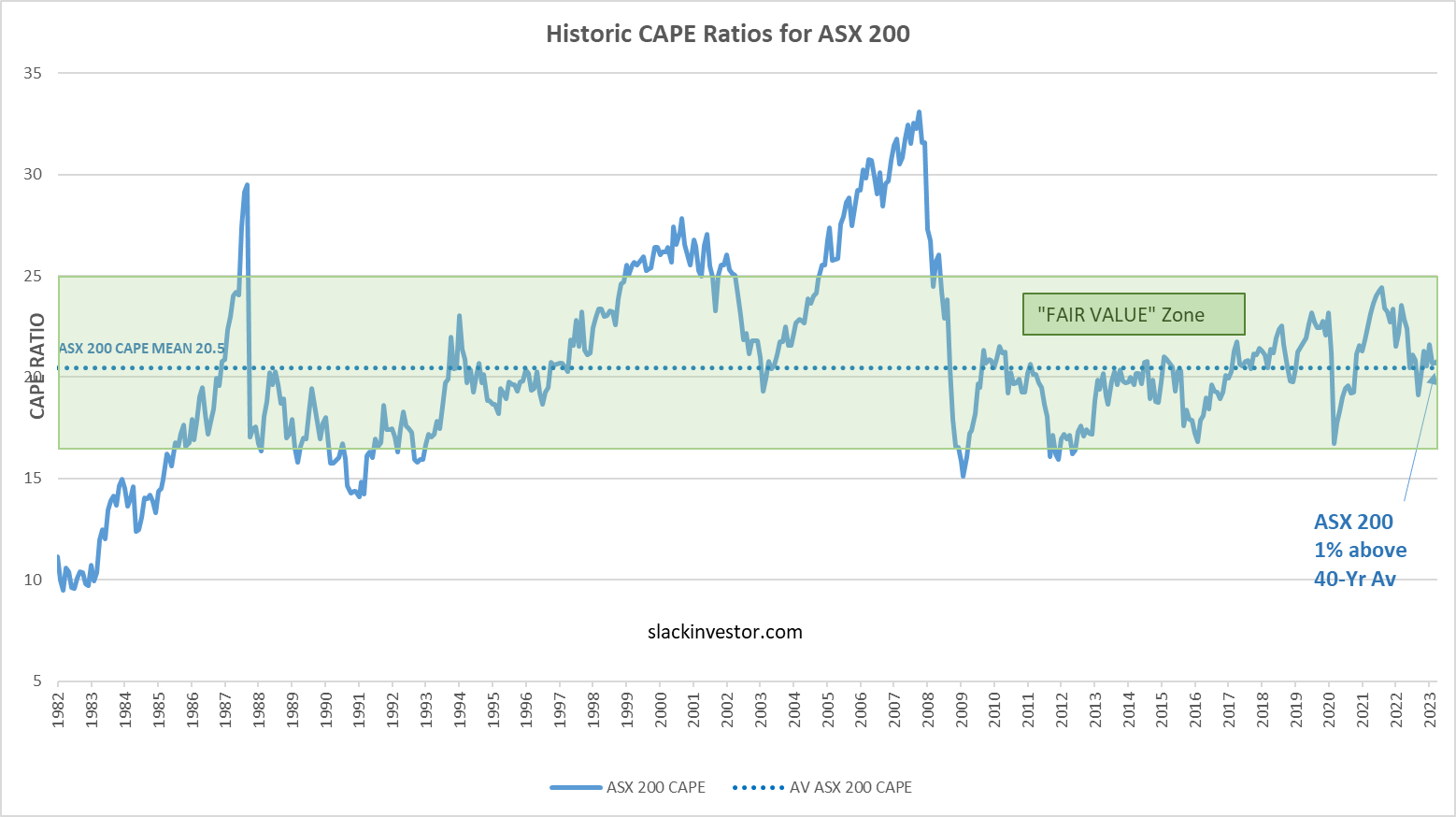
Slack Investor also likes to keep up to date with how the markets are travelling for value and he has been using charts for the Cyclically Adjusted Price to Earnings ratios (CAPE). This value is also known as the Shiller P/E Ratio after Robert Shiller the economics professor that made this measure popular. Slack Investor first started using CAPE as a ‘value’ tool in September 2021. The most recent post on Market Value was mid-April 2025 about 6 months ago.

For the following charts, Slack Investor uses monthly CAPE data from Barclays, the 40-yr mean is calculated and plotted together with the latest actual CAPE values up until 31 October 2025. A ‘fair value’ zone is created in green where the CAPE is within one standard deviation of the mean (average) – click images for better resolution.

ASX 200 CAPE Value 22.89 (11% above long-term av.)

ASX CAPE values – up to 31 October 2025

FTSE 100 CAPE Value 18.24 (5% above long-term av.)

UK CAPE values – up to 31 October 2025

S&P 500 CAPE Value 39.76 (59% above long-term av.)

US CAPE values – up to 31 October 2025

The UK and Australian markets are not too overvalued. However, in terms of the Shiller P/E the S&P 500 has entered some lofty territory. Unfortunately, whenever the S&P 500 has a large correction the effects are usually felt in other markets.

There is some good research that links CAPE to long-term returns … and future returns are what gets Slack Investor excited. The predictive skill of the Schiller CAPE is not very good over 1-yr and 5-yr periods. However, it does show some skill for periods of 10 years and longer. The tight spread around the trend line indicates that the Shiller P/E might have some predictive skill.

Shiller P/E and S&P 500 10-year annualised forward returns since 1983. The data shows 41 years of S&P 500 10-year average annual returns based upon the Shiller PE ratio (from 10 years ago). Slack Investor has modified the chart and circled the 10-year average returns based upon the times when the Shiller P/E was previously around 40 – From Invesco.com

If this relationship holds, the average S&P 500 10-year annualised forward returns are predicted to be close to zero or negative. This indicates that now is not a good time to start buying the S&P 500. Tech stocks (with high P/E) have fallen sharply lately and this could be early signs of a readjustment.

Slack Investor is not one with predictive skills. He just plods along – staying mostly invested and knowing that he has his stable income pile to ride out any market gyrations. Cripes … even the great Warren Buffet’s Berkshire Hathaway stock had 11 negative years between 1965 to 2024. Slack Investor could only dream of emulating the Buff’s long term compounded annual return of 19.9% over 55 years.

The Minutia of Investing – Portfolio Tracking and Tax Reporting

Slack Investor has just finished the inputs for his family tax returns and our SMSF tax return. All Good – and he was pleased that it was a painless procedure. After many years of investing, he has got himself organized.

A lot of the tax-time pain has been erased because of his disciplined rituals. As soon as he gets a communication about his shares (usually email) it is downloaded to one of Slack Investor’s Finance folders on his PC. The Finance folder has two sub-folders one for Transactions (Buy/Sell contract notes from Brokers) and, another for communications from Share Registries labelled DIVIDENDS_TaxStatements. He then saves items in these folders with specific notation Account_StockSymbol_Type of document_Date of issue (YYYY-MM-DD). For Tax Statements, Slack Investor will allocate the date for the end of tax year that the statement covered. After completing tax returns, Slack Investor will archive the files to the folder for the previous tax year – and start again for the current year.

Slack Investor’s Portfolio Tracking

Microsoft Money Sunset

Slack Investor will also enter any transactions or income events into his portfolio tracking software. He uses the retired but excellent (and free) ‘Sunset’ International English version of Microsoft Money downloaded from Gareth J. M. Saunders site. There is also a UK Version, and a US Version.

To automate share price updates it is necessary to use a service like  MSMoneyQuotes. The latter is not freeware but the $US10 lifetime licence is money well spent. MS Money is now a 20-yr old bit of software and is a bit clunky but there is a good installation guide at TechFinitive that will help you through – including some registry changes to work with windows 10/11. Slack Investor loves MS Money, and the many support sites, e.g. View from the Potting Shed which has a free support pdf available, Ameridan’s Blog and moneymvps.org. He has been using versions of MS Money for 30 years!

For those who don’t want to wander through the complications of the Microsoft Money path, it is really important to track your portfolio for capital gains and performance, and at least some sort of portfolio tracking is recommended. Slack Investor cannot stress this enough. The ATO will want information when you sell stocks. They require your sell date and price, and the harder to find, buy date and initial cost of your shares/ETF’s – in order to calculate any capital gains tax. This procedure can get complicated when you buy shares in different lots or, participate in a dividend re-investment program as the ATO require a cost-basis for each parcel. It will make your life easier if you have a portfolio manager or, at least, a capital gains tracker.

Portfolio Tracking with Monthly Fees

For Australians, the slickest products involve an annual/monthly cost as good financial software requires constant development.

Sharesight

A highly-rated financial portfolio tracker that includes tax statements and capital gains tracking for $228 annually for one portfolio or $348 annually for up to 4 portfolios. Sharesight used to have a free version that included tax reporting for one portfolio with under 10 shares. However, they have now dropped tax reporting privileges for free accounts.

Navexa

Another nice looking and highly-rated product. A financial portfolio tracker that includes tax statements and capital gains tracking for $240 annually for one portfolio or $300 annually for up to 3 portfolios.

Snowball

This is a US-based portfolio tracker so it will not help greatly with your Australian tax reporting. However, it is a highly-rated and a good looking way to track your Australian and US shares for around $130 AUD annually for one portfolio or $230 AUD annually for up to 10 portfolios.

Finance Tracking without Monthly Fees

Down at the budget end we have products that require a bit more work. There are a few other alternative finance products that are discussed in Whirlpool – but Slack Investor presents a few solutions below.

Yahoo Finance

This is a very basic tracker that can track your overall portfolio performance if you enter your buys and sells and dividends manually. Slack Investor uses Yahoo Finance to keep an eye on the day to day movements of his portfolio plus watchlists. There is no tax reporting or help with capital gains, but Yahoo Finance is a free portal to track your portfolio and it will have your buy and sell information in one place.

Stock Profit

An excellent free alternative to portfolio tracking is the google sheets based Stock Profit. There is a bit of a effort in setting it up but it will track your performance and capital gains with ease. This really is a good product.

Capital Gains Tracker

If you are not worried about portfolio tracking you will make your life easier at tax time if you have some means of tracking capital gains and the free web-based but locally stored cgtracker will supply you with capital gains information and tax statements. Capital Gains Tracker is free to use but you must enter all your buy/sell information.

Personal taxes and Mytax

Firstly, a ‘Hats Off’ to the ATO who have made their online tax returns (MyTax) a very simple process with the ‘pre-filling’ of wages, dividends and distributions. Slack Investor usually waits till September to allow all the pre-filling documents time to trickle in to the ATO. It is now incredibly easy to fill in a tax return yourself and only those with very complex tax affairs should need an accountant.

If your tax affairs are relatively straightforward, MyTax is a fast, free and effective way to lodge your return online. It puts control in your hands, provides instant access to pre-filled information, and helps you get your refund sooner. Tax Window

By September, all of Slack Investor’s personal tax information was pre-filled, including the distributions from ETF’s that often have internal capital gains and foreign income. He had additional capital gains from share selling and opted to use their Capital Gains Worksheet which was part of MyTax – it already had the small ETF internal capital gains prefilled and he just had to add buy dates and costs for each lot of shares sold. Slack Investor had all of this information on MS Money – but any capital gains tracker would have this information in one place. For advice on any problems with MyTax, he went to the ATO community rather than the official ATO site – which often has opaque, or vague, solutions to your problems.

SMSF Tax Return

Slack Investor started the process in October when his provider (Esuperfund) prompted him to allocate categories to each of the transactions for his SMSF Bank account. All the dividends and distributions were pre-filled but he needed to label the type of contributions (concessional/non-concessional) and the relevant member of the SMSF. Also, he had to determine from which pension account any withdrawals came from. There was some head scratching to make sure the minimum amount withdrawal requirement (5% age 65–74, 4% age under 65) from each pension account had been fulfilled.

Slack Investor had to assure Esuperfund that he hadn’t bought any exotic assets outside of their monitored banks/brokers. He also had to upload Tax Statements from each of the ETF’s in the SMSF portfolio. Luckily, they were all in one place in my Dividends_Tax Statements folder. He submitted the checklist and now have to wait a long ~7 months – till May 2026. By which time, Esuperfund will have obtained an Auditor’s review and will present the trustees with the 2025 SMSF Tax Return to sign.

CSL – Is Slack Investor flogging a dead horse? – September 2025 End of Month Update

CSL Price Chart – Market Index

Apologies to all readers who may have jumped on the CSL train in the past 5 years due to Slack Investor continually ‘bigging up’ this grand old stock. He has always been impressed with companies that spend a good portion of their profits in Research and Development.

‘CSL have committed to spending 10% of global revenue on R&D for new and existing products.’ Livewire

Slack Investor has been a holder of this company since the ‘good old days’ (before 2020). But has occasionally topped up when the price dipped below $300. So, he does share some of the recent pain.

The latest price slump was on the back of the FY 2025 results and the announcement that one of CSL’s components, CSL Seqirus, was to be demerged. The markets were not that impressed with the planned restructure and slowing growth momentum.

However, some sectors of the business are doing well. CSL Behring and CSL Vifor reported strong growth.

This CSL horse should have some good riding ahead

The 2025 AGM indicated that management were taking the knife to costs and staff in a restructure of the business that is underpinned by the Seqirus spinoff and $500 million in pre-tax savings.

Despite all the headwinds from competition and regulatory price cuts, they’re (CSL) still growing double digit. I think that’s a pretty good business.Daniel Moore – IML, reported in Livewire

When nervous … Slack Investor will always go back to the numbers. Market Screener – Finance Tab for CSL supplies some of the answers. The Income chart looks healthy.

Income (Black) and projected income (Striped Grey) for CSL – Market Screener

Looking at the projected PE, ROE and growth from Market Screener – future predictions look OK.

Perhaps the big growth days of CSL are in the past due to the more competitive environment in some sectors of the business. However, Slack Investor is a long-term investor in CSL and happy to hold. He would buy more – if CSL wasn’t already 8.1% of portfolio.

September 2025 – End of Month Update

Another wild month. The S&P 500 (+3.5%) and the FTSE 100 (+1.8%) remain in all time high territory. The ASX 200 sputtering and down 1.4% for the month.

Slack Investor remains IN for all markets.

The recent strength of the US market has pushed the closing monthly value to more than 15% above my old stop loss. I adjusted the stop loss upwards to a new ‘higher low’ of 6212 for the S&P 500.

All Index pages and charts  have been updated to reflect the monthly changes – (ASX IndexUK IndexUS Index).

The quarterly updates showing the current holdings and cash position of the Slack Portfolio have also been completed.

Financial Year 2025 – Full Slack Results

In God we trust; all others bring data.

W. Edwards Deming Statistician/Consultant (1900–1993)

Slack Investor likes to measure things, especially long-term results. In the world markets, for FY 2025, the FTSE 100 Total Return Index was up 10.8% (FY 2024 up 11.8%). Dividends helped the Australian Accumulation Index to be up 9.0% for the financial year (FY 2024 +12.2%). The S&P 500 Total Return Index is again the top performer – and was up 15.2% (FY 2024 +24.2%). All of these Total Return Indices include any accumulated dividends.

Slack Investor has stuck to his strategy of mostly investing with growing companies that are profitable (Return on Equity >15%), have an established earnings record and, not too expensive (forward P/E ratios <50). He expects a bit of volatility in his growth oriented investment portfolio. He is reassured that, despite the odd negative year in the Slack Fund, the dividends and his separate Stable Income portfolio are doing what they should – keeping Slack Investor with enough cash to ‘keep the wheels on’ the Slack lifestyle – should the stock market sour.

Slack Portfolio Results FY 2025

All Performance results are before tax. The Slack Portfolio is Slack Investor’s investment portfolio. He is glad to report an annual FY 2025 performance of +18.1%. Full yearly results with Australian benchmarks are shown in the table below. Slack Investor realises that only long-term results really count.

For property values, Slack Investor is using the Home Price Index supplied by PropTrack. The Index uses median values for each city – I would have preferred calculations that include the net rental yield, but this will have to do. Of course, the real estate industry avoids true measurement of real estate performance by collecting figures only on gross price changes – they ignore the significant transfer costs involved (Stamp Duty, Conveyancing, Bank Fees, etc) and, the costs of any home improvements and renovations.

For FY 2025, the Australian Share market Total Return Index (ASX200 Acc) was up 9.0%. The Vanguard Diversified Growth ETF (VDGR), comprising International shares (42%) and Australian Shares (28%), increased by 12.7%. Inflation is now within the Reserve Bank target – with the CPI at +2.1%.

The Cash rate of 4.3% is above inflation. Cash is important – but not a way to grow your wealth. The average readily available cash rate of return since 2010 is 2.6% and, for cpi measured inflation, it is 2.7%.

Yearly Performance (%) results since 2010

The Slack Fund yearly Internal Rate of Return (IRR) vs BENCHMARKS. The Median Balanced Fund (41-60% Growth Assets)Vanguard Growth FundASX 200 Accumulation IndexPropTrack Home Price Index in both Brisbane and Melbourne, and Cash (Australian Super Cash Fund) and Consumer Price Index (CPI). AV. YEARLY is the annual mean of all the data since 2010.

5-yr Average Annual Performance

Although Slack Investor collects yearly figures, the 5 and 10-year compound annual performance gives me a much better idea about how things are really going. Long-term results will smooth out any dud (or remarkable!) yearly figures. The Slack Fund is still ahead of most Benchmarks – but running a close second is Brisbane Residential real estate over a five-year period.

The Slack Fund average 5-yr compound yearly return vs BENCHMARKS in chart form.

10-year compound annual rate of return

The Slack Fund has been around a while and generating some good long term data (10-year compound ‘rolling’ annual rate of return). Over this time frame, the Slack Fund has been performing very well. For FY 2025, a 10-year annual rate of return of over 17% – Go Slack Fund! The 10-yr data is shown below in table and chart form.

It is useful to note that, the 10-yr rates of return for the Median Balanced Fund, Vanguard Growth fund, ASX200, and residential property in Brisbane and Melbourne are also good long-term investments. These appreciating assets generate a 10-yr compound annual rate of return in the region of 6-9% p.a.

The Slack Fund average 10-yr compound yearly return vs BENCHMARKS in table form. Prior to 2022, 10-yr Vanguard Growth fund figures were not available. AV. YEARLY is the annual mean of all the data since 2019.

Although Cash is necessary to add stability and flexibility to a portfolio. From the chart below, Cash as a long-term investment vehicle, is a poor choice.

The Slack Fund average 10-yr compound yearly return vs BENCHMARKS in chart form.

15-year compound annual rate of return

Perhaps because Slack Investor is showing signs of age, he notices that there is enough accumulated data for rolling 15-yr rates of return. Happy to report solid long-term results.

The Slack Fund average 15-yr compound yearly return vs BENCHMARKS in table form.

Growth of a $10 000 Investment Since 2009

The beauty of compounding with a succession of good performance results can be seen in the chart below showing the growth of an initial investment in June 2009 of $10 000.

The growth of $10 000 invested in the Slack Fund vs BENCHMARKS. The Median Balanced Fund (41-60% Growth Assets)Vanguard Growth FundASX 200 Accumulation IndexPropTrack Home Price Index in both Brisbane and Melbourne, and Cash (Australian Super Cash Fund).

The Slack Fund has exceeded my expectations. Also, the chart shows that investing in either shares or residential property has been a solid way of growing your money over the long term.