Slack Portfolio Surgery – February 2026 End of Month Update

Robert Liston operating. Painting by Ernest Board of Bristol (1877-1934) – Wikimedia Commons

The leg amputation depicted above was supposedly done in under 30 seconds. Dr Liston not only managed to kill the patient (Sepsis), but one of his assistants (Sepsis) – and also one of the audience (shock). A 300% mortality rate! Slack Investor hopes for a better outcome after some recent portfolio surgery.

SaaS-pocalypse

The ‘SaaS-pocalypse’, a trending term to describe the recent and dramatic sell-off in global Software-as-a-Service (SaaS) shares, is based on the idea that AI becomes so advanced that software becomes redundant. – The Guardian

Slack Investor went into a bit of detail last post on the sell off in tech and healthcare stocks due to the release of AI tools such as Claude. This wasn’t just some tale in a distant land, the ‘SaaS-pocalypse’ was having a very direct affect on the Slack Portfolio.

ASX200 biggest falls since August 2025 (Data as of 4/2/2026) – Livewire

Is this really a disaster for the Slack Portfolio? Slack Investor prides himself on getting things ‘mostly right’. However, this 2026 Financial Year has been testing – it seems that he has been getting things ‘mostly wrong’! However, Slack Investor knows that only long-term results count.

It is certainly a setback, as Slack Investor has attached himself to 5 of these ‘Biggest Fall’ ASX companies set out above. Some remedial action is required.

Slack Investor has been in this game long enough to not panic. He has however given the Slack Portfolio a ‘very hard look’ and has been gradually building up his cash position by selling companies that have not a convincing story to tell in these frothy times – particularly those with an extended PE Ratio. Future incomes may not be enough to justify their expense (high PE Ratio). He is mindful that the recent sell-off might be overdone in some cases.

But the companies being indiscriminately sold are often those whose actual protection was never in the codebase to begin with. The durable moats live outside the software entirely, in proprietary data rights, regulatory licences, institutional relationships, deep workflow embedding, and sustained frontier research. None of these can be prompt-engineered into existence. – Mark Gardner, MPC Markets –Livewire

Since his last published quarterly portfolio, Slack Investor has reduced his exposure to the US market (Sold NVDA, NDQ, JNDQ) and sold off some of his more speculative holdings (TLX, MP1 and CXL). His cash position is healthy and waiting for some future opportunities. His Stable Income pile plus Slack Portfolio dividends are enough for living expenses and holidays. Slack Investor should never be forced into a sale of his stocks.

Rules of thumb when bad things happen

Slack Investor has general rules of thumb for when stock prices have a fall of 20%. These questions must be asked.

  • Has something fundamentally changed with the company? Such as sustained falling earnings, new competitors, etc.
  • After running the numbers for predicted PE Ratio, predicted ROE and predicted growth. Would Slack Investor buy this company at the current price?

As well, for SaaS stocks, Slack Investor has another question.

  • Does the company produce proprietary software and embedded relationships with its clients that would provide a durable moat?

These three questions were enough for me to hang on to my battered software-based stocks TNE, CAR, REA, and WTC – and hope for a recovery.

February 2026 – End of Month Update

Slack Investor remains IN for Australian index shares, the US Index S&P 500 and the FTSE 100.

Despite the turbulence in the Slack Portfolio, it was a good month for the ASX 200 (+3.7%). The FTSE 100 is in record territory with 6.7% February growth. A well deserved rest for the US markets (S&P 500: -0.9%).

All Index pages and charts have been updated to reflect the monthly changes – (ASX IndexUK IndexUS Index).

Hi Claude … I wasn’t expecting you

Slack Investor likes to keep up with investor news and he was a bit slow with the emergence of the Claude Cowork platform. Claude Cowork is built by Anthropic as a way to bring the command line Claude Code tool to non-technical users. Claude Cowork is available as a desktop application for MacOS and Windows. This is just another way to help take AI into the workplace. Amazingly, the entire Claude Cowork feature was built in approximately ten days using Claude Code itself.

Since the release of this new platform, on fears that Claude is a bit of a gamechanger, software stocks have lost over 1 Trillion USD since the start of this month.

A legal firm conducted a test that asked Claude Cowork to draft a contract and critically read another legal contract to point out concerning clauses for a risk-averse client. The task was completed in seconds and was ‘Bang On’.

“I thought it was great. If I got that from a junior lawyer after they worked on that for hours I would be pleased. … It was clear, it was concise, it accurately reflected the commercial context Sarah Pool, Lawyer and founder of EstateXchange

Claude is not limited to the legal field. Apparently he is a deft hand at coding and assembling software. A Livewire article by Luke Hopewell has left quite an impression on Slack Investor. Early this month, the Xero CEO Singh Cassidy, who manages a very successful accounting software service stated: ‘Xero couldn’t be easily cloned with AI’. Further, ‘Investors are failing to differentiate between software tools that can be easily replicated and those that cannot’.

Luke Hopewell is a tech contributor to the Switzer report and has held editorial roles with Twitter and Gizmodo. He obviously has good tech skills … and he accepted the challenge and offered the task to Claude Cowork.

The article is well worth the read and he asked Claude if it could replicate the Xero software with Claude Code. It didn’t take Claude long to assemble 21 different pieces of financial software to mimic the Xero suite – at zero cost! This compares with Xero packages for small business which start at $75 per month.

Mr Hopewell admits that the Claude derived suite was clunky and ‘a pain to try and get running‘. This Claude assembled software is unlikely to satisfy a business owner who wants a seamless well designed product. However for something conjured up in a few minutes, Claude’s work is pretty impressive – and pretty cheap!

Claude and other AI developments have spooked the tech stocks

Claude Cowork and other AI-sourced jitters have set off a big slide in Healthcare and Software as a Service (SaaS) companies. Since August 2025, there have been falls of between 25% and 50% for some ASX stocks. Sadly for Slack Investor, these are just the type of profitable, low-overhead businesses that he likes and owns. He has been selling some of his tech stocks (but not enough!) whose chart patterns resemble ‘falling knives‘ – hoping to get back in when things stabilize.

As impressive as Claude is, there are a few hardy souls who maintain the recent sell-off of the SaaS stocks is a bit overdone. Slack Investor can comprehend that this type of intuitive AI software represents a massive change to the way we work. Businesses in many fields (legal, administrative, graphic design, financial, etc.) will have their earnings model challenged. However, he thinks that despite the industry-wide downturn, there should be a move towards quality businesses with platforms that are essential and AI-resilient.

This fear has been applied largely indiscriminately, with little consideration given to whether software platforms are embedded in core workflows with control of data and distribution – Jai Mirchandani – ELM Responsible Investments

At the recent ProMedicus AGM, the CEO Dr Sam Hupert was asked whether their main software tool Visage was under threat from AI if anyone will be able to use AI tools to write industry grade software in a fraction of the time.

This, in our view, is an overly simplistic generalisation, one that certainly doesn’t apply to us. Visage 7 was built from the ground up using our own proprietary technology. It is not based on some readily available tool kit or platform. It is a very specialised, highly technical, patented suite of software that incorporates more than 30 years of domain knowledge; it is not a product that can be readily replicated with or without AI. We have not left a roadmap for others to follow. – ProMedicus CEO, Dr Sam Hupert

Slack Investor is still a bit stunned by this rapid re-rating of all software related stocks. In the tech sector, the market is obviously not willing to pay the high P/E multiples on the promise of future earnings.

This may be wishful thinking, but Slack investor thinks Dr Hupert is right … and this AI scare for complex software products that are embedded in their clients workflow has gone way too far. Good companies will develop their own AI tools to enhance their software. It is time to focus on only high quality SaaS companies with a moat that Claude-type things will have difficulty in crossing. Time to get off the couch.

Warren Buffet and Market Value – November 2025 Update

Warren Buffet and his offsider the late Charlie Munger are dead set Slack Investor Heroes – and a reminder that the USA offers a crucible for outstanding qualities to emerge in individuals – as well as, in some presidential types, some not so good qualities. Mr Buffet is a great investor and philanthropist and full of insightful but humble advice that is worth heeding. Every November he writes a letter to his Berkshire Hathaway shareholders and it is a delight to read in full. This will be his last shareholder letter as he is retiring at the grand age of 95.

‘Our stock price will move capriciously, occasionally falling 50% or so as has happened three times in 60 years under present management. Don’t despair; America will come back and so will Berkshire shares.’ – Berkshire Hathaway 2025 Newsletter

Even investors as great as Warren Buffet are not immune to large market swings. After all, it is your long-term performance that is the most critical for a lifetime investor.

‘Since 1965, shares of Warren Buffett’s conglomerate, Berkshire Hathaway (BRK.B), have delivered a compounded annual return of 19.9% — almost double that of the S&P 500 over the same period.’ Investopedia using data from the Berkshire Hathaway 2024 Newsletter

Warren Buffet liked to look at current market valuation (S&P 500) as a ratio with the current US Gross Domestic Product (GDP). At 30 June 2025 the ratio was 217%. A long way above the trend line and a warning that the S&P 500 was growing at a rate much faster than the general economy – this is a danger sign.

The Buffet Indicator is the ratio of the total United States stock market to GDP. The ratio is now two standard deviations away from the historical trend line – from Current Market Valuation

Market Value – November 2025 Update

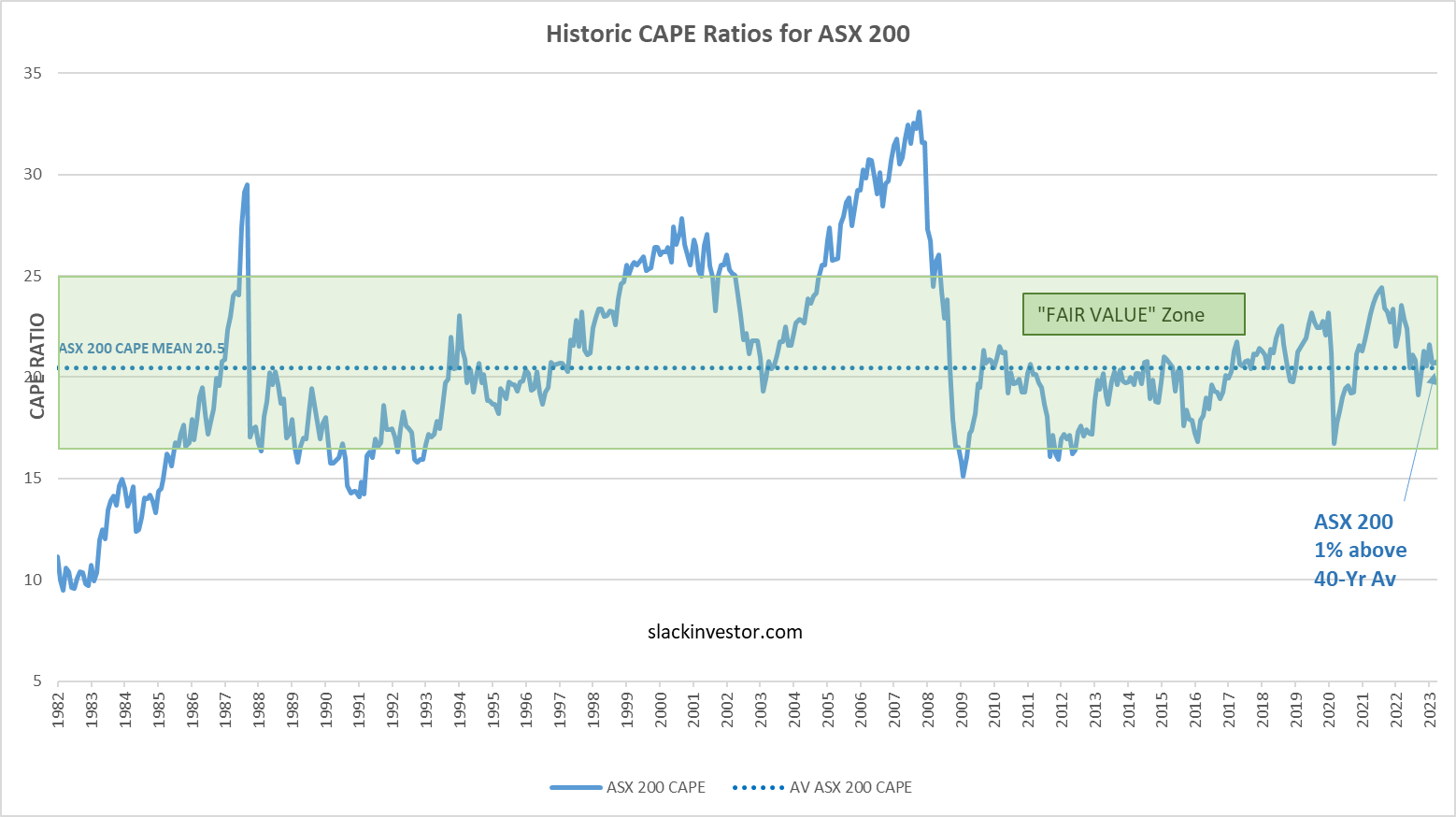
Slack Investor also likes to keep up to date with how the markets are travelling for value and he has been using charts for the Cyclically Adjusted Price to Earnings ratios (CAPE). This value is also known as the Shiller P/E Ratio after Robert Shiller the economics professor that made this measure popular. Slack Investor first started using CAPE as a ‘value’ tool in September 2021. The most recent post on Market Value was mid-April 2025 about 6 months ago.

For the following charts, Slack Investor uses monthly CAPE data from Barclays, the 40-yr mean is calculated and plotted together with the latest actual CAPE values up until 31 October 2025. A ‘fair value’ zone is created in green where the CAPE is within one standard deviation of the mean (average) – click images for better resolution.

ASX 200 CAPE Value 22.89 (11% above long-term av.)

ASX CAPE values – up to 31 October 2025

FTSE 100 CAPE Value 18.24 (5% above long-term av.)

UK CAPE values – up to 31 October 2025

S&P 500 CAPE Value 39.76 (59% above long-term av.)

US CAPE values – up to 31 October 2025

The UK and Australian markets are not too overvalued. However, in terms of the Shiller P/E the S&P 500 has entered some lofty territory. Unfortunately, whenever the S&P 500 has a large correction the effects are usually felt in other markets.

There is some good research that links CAPE to long-term returns … and future returns are what gets Slack Investor excited. The predictive skill of the Schiller CAPE is not very good over 1-yr and 5-yr periods. However, it does show some skill for periods of 10 years and longer. The tight spread around the trend line indicates that the Shiller P/E might have some predictive skill.

Shiller P/E and S&P 500 10-year annualised forward returns since 1983. The data shows 41 years of S&P 500 10-year average annual returns based upon the Shiller PE ratio (from 10 years ago). Slack Investor has modified the chart and circled the 10-year average returns based upon the times when the Shiller P/E was previously around 40 – From Invesco.com

If this relationship holds, the average S&P 500 10-year annualised forward returns are predicted to be close to zero or negative. This indicates that now is not a good time to start buying the S&P 500. Tech stocks (with high P/E) have fallen sharply lately and this could be early signs of a readjustment.

Slack Investor is not one with predictive skills. He just plods along – staying mostly invested and knowing that he has his stable income pile to ride out any market gyrations. Cripes … even the great Warren Buffet’s Berkshire Hathaway stock had 11 negative years between 1965 to 2024. Slack Investor could only dream of emulating the Buff’s long term compounded annual return of 19.9% over 55 years.

Ride that Horse! – October 2025 End of Month Update

Calgary Sun

Slack Investor reads a lot of finance news each week. Sadly, there now seems to be a portion of the finance news that seems to come from AI sources. However, there is still a lot of good stuff by real people – and he came across an excellent article by Carl Capolingua that had some great investor truths that apply to the current market.

A disciplined investor doesn’t fight the market – they respect it. They accept the market is responsible for their investing outcomes, win, lose or draw. They also accept that they have absolutely no control over the market or the outcomes it delivers. – Carl Capolingua, Livewire Markets

The original article focuses on the difficulty of letting go of investments that have shown a loss. Slack Investor is still searching for this zen state and has written about his own troubles with selling stocks that have had a sudden fall. However, the quote above sums up ‘the bargain’ that Slack Investor has made with stocks and their volatility. I don’t know when the next correction (or worse!) is coming … but I know it’s coming.

World Markets are Expensive at the Moment

Although Slack Investor collects his own data on relative market value using CAPE numbers, the remarkable Ashley Owen has produced a great graphic showing the relative size of the world markets and how expensive they are at the moment in terms of PE and Yield. Clearly, the US market looks over ripe and any corrections here will historically influence all other markets.

World markets plotted by PE Ratio and Yield – From the very erudite Ashley Owen of Owen Analytics

Short-term Returns are Volatile

The chart below shows that the S&P 500 returns for a calendar year are all over the place, but if you just hung on, and didn’t sell the S&P 500 when times were tough, you would be rewarded with an average annual return of 12.2% over 30 years. Not Bad. Australian shares have returned an average yearly gain of 11.5% from 1900 to 2020.

Yearly Returns of the S&P 500 (green columns) and 15-yr rolling returns (blue line) – From T. RowePrice

What to do when the Correction comes

‘If you have trouble imagining a 20% loss in the stock market, you shouldn’t be in stocks.Vanguard founder – John C. Bogle

Slack Investor has had no real luck in timing the markets – despite a disciplined 21-yr project trying to do this. There are those that can, Marcus Padley and his investment team have gone to 100% cash and reported this on 21 October 2025. Slack Investor hasn’t the knowledge, or gumption, to confidently predict market exits and entries – and yet, has done OK in the investing business without too much angst.

Slack Investor knows that for an ordinary person, the stock market is the place with best long-term returns with minimal transaction costs. The bargain – to accept volatility in return for long-term gains – is accepted.

  • He has his stable income pile to keep the dogs from the door.
  • He tinkers with his Investment Portfolio of predominantly growth shares, but mostly he leaves it alone.
  • He will not sell his shares after a correction and convert to cash.
  • He has elevated his cash position slightly (6% cash, 94% invested) in case some bargains come up post-correction.

These are choppy times and there is an uncertain near-term future – situation normal in the stock market. Some of his portfolio (e.g. CSL, WTC, TLX) have had big falls lately. However, Slack Investor has had a look at future revenue predictions and has not completely given up on these stocks. Though, CSL is losing its shine as a growth company in Slack Investor terms.

He will keep riding that stock market horse … and push to the forefront of his mind the pleasant times at the rodeo bar with his cowboy mates … reflecting on our glorious achievements.

October 2025 – End of Month Update

Slack Investor is IN for Australian index shares, the US Index S&P 500 and the FTSE 100.

The S&P 500 (+2.3%) and the FTSE 100 (+3.9%) have continued their strong monthly growth. Slack Investor is pleased to stay on board but there he remains nervous about the US markets. For the ASX 200, (+0.4%) a flat month with plenty of volatility.

All Index pages and charts have been updated to reflect the monthly changes – (ASX IndexUK IndexUS Index).

Market Timing Experiment – Update

Apologies for intruding into your inbox. I like to keep the Slack Investor blog folly to twice a month. But these are unusual times.

The Slack Investor Market Timing Experiment

Slack Investor started his ‘index-timing’ strategy in 2004 with the ASX IndexUK IndexUS Index. An earlier version of Slack Investor thought that by monitoring the market at weekly and monthly intervals and setting ‘stop losses’ to know when to sell the index. To know when to buy, he used a momentum indicator called the Directional Movement Index.

Although, there was some initial success over the ‘buy and hold’ strategy, the benefits work out to be quite small on a yearly basis. For example, for the Australian Index there is a 1.2% p.a. outperformance for Slack market timing strategy over ‘buy and hold’.

These relatively small gains would have probably been offset by earned share dividends if I was using the alternative ‘buy and hold’ strategy. Market timing works well when there are sustained periods of bull and bear markets and the changes between the two are not too rapid. The short transitions and the speed of market fluctuations in the last 20 years has forced a bit of a rethink on Slack Investor’s timing the markets strategy.

Instead of monitoring the markets monthly, he has been looking for weekly changes as well. He is also taking the current market value and recent trends into account. Slack Investor is a man of routine and he has now decided to keep the experiment going for 25 years (till 2029). After this, he will probably go for the more appropriate Slack Investor method of doing nothing and adopting a ‘buy and hold’ technique for index funds (ASX IndexUK IndexUS Index).

US Index – Slack Investor is OUT

Monthly chart S&P 500 up until Friday April 4 2023 – incrediblecharts.com

At the end of the past week, Slack Investor conducted a review of the Index charts and noted that the US Index price has slipped below the stop loss (thick red line). As the trend is still downward, and the market is overvalued (see below), it is time to get out. As part of this experiment, I will sell my small holding of S&P 500 Index tomorrow and update the US Index page.

US CAPE values – up till the end of March 2025 showing the index is still overvalued (at March 31). The CAPE ratio is above the green zone.

What about the rest of the Slack Portfolio?

Deep down, Slack Investor doesn’t believe he is very good at timing the markets. The bulk of the Slack Portfolio (97%) is not in index funds, but in growth companies – that are taking a bit of a beating at the moment. That’s what the stock market does in times of uncertainty.

Mostly, Slack Investor will be doing nothing. He will try and distract himself from the self-destructing behaviour of Trump. I cannot remember a time where the whole world was so united in its resolve against the USA. Slack Investor knows that good times (and prices) will return. Slack Investor has his Stable Income Portfolio if he needs cash.

The worst thing to do, from a long-term wealth perspective, is to convert shares to cash in a down market – Slack Investor (and other wise investors!)

On the back burner is my project to sell some of the Slack Investor owned companies with a relatively low Slack Factor – and invest more in those with a high Slack Factor.

Trumpenomics … Be Brave!

The talented David Rowe shows ‘Me the People’ Donald Trump and his entourage re-enacting George Washington’s crossing the DelawareAustralian Financial Review

Because I can’t resist David Rowe images of Donald, in the above cartoon he is shown leading the way – his loyal band of grifters, scammers, chancers and influencers are happily along for the ride. Slack Investor still finds it hard to believe that Trump has been elected again by the US people. This ‘second coming’, and all its associated upheaval and chaos, has been going on for less than two months!

‘The stock market is going to be great’ – Donald Trump – Investor Conference, February 19, 2025 – Rollcall.com 

Perhaps I am selling Donald a bit short here, and Slack Investor hasn’t given his ‘genius’ policies the chance to work through in the long term. Although, picking a trade war with Canada, Mexico and China (and now, the rest of the world!) may not be seen by history as one of Trump’s ‘genius’ moves. Tariffs make imported products more expensive than domestic ones and might make sense in a limited way if you are trying to encourage local production. However, they inhibit trade and make goods more expensive. Virtually all economists think that the US tariffs will be bad for America – and for the world. So far, it is certainly bad for the stock market.

This is not a political blog, but Trump’s anti-science and chainsaw approach to cutting government departments seems random and very short-sighted. Also, Trump’s treatment of Ukraine using standover tactics on mineral deals, his commitment to the rich getting richer, his rejection of international treaties, and his ‘negotiating’ a Ukraine surrender on Russian terms – are all just appalling acts to Slack Investor.

What to do in times of Market Crisis?

Slack Investor would love to have some cash reserves while prices are low, however he is in retirement mode and fully invested. There might be some tinkering with the portfolio but, he will do mostly nothing. Slack Investor has his Stable Income Portfolio if he needs cash. If there is a need to sell any stocks, he will be buying other stocks in the same market. The worst thing to do, from a long-term wealth perspective, is to convert shares to cash in a down market.

Individuals who cannot master their emotions are ill-suited to profit from the investment process. Benjamin Graham, Legendary Investor and Author

Despite the Trump administration commitment to ‘Alternative Facts’. Slack Investor is guided by some established facts.

  • The stock market is the best asset class for long-term returns above inflation. See the Vanguard 2024 30-Yr chart or Long Term Returns. This is the premium game in town for non-business owners to increasing wealth.
  • The stock market is volatile. There will always be the swings between the market being overpriced, or underpriced, due to the news of the day. After a correction/crash, the market has always recovered to new highs. This happened after: Gulf Wars, Israel/Ukraine/Gaza invasions, terrorist attacks, GFC, COVID-19, etc. Trumpenomics is just one of those things that will affect the market in a temporary fashion.
  • On average, the sharemarket falls by:
    • 5% – about 3 times a year
    • 10% – about once a year
    • 20% – every 3-5 years.
  • Timing the market is just too hard (for Slack Investor). I have a long-term experiment going where I try to time the market in a methodical way using the ASX Index, the UK Index and the US Index. After 20 years, Slack Investor is either marginally ahead, or marginally behind, the markets. In all cases, in hindsight, he would have been better to buy and hold – and collect the dividends throughout.

There is still a need to constantly review your portfolio

‘I don’t think people understand there’s 100% correlation with what happens to a company’s earnings over several years and what happens to the stock.’ Peter Lynch, Legendary Investor, Slack Hero

In view of Peter Lynch’s wisdom, as the Australian reporting season is over for the first half of FY 2025 (up to the end of December 2024). I will do a review of my current holdings next blog to ensure that they are still, mostly, growing earnings companies.

Just a few of Trump’s quotes to mull on from shortlist.com. The Clown Prince Donald always has a lot to say …

‘I look very much forward to showing my financials, because they are huge.’ TIME, 14/4/11

‘My fingers are long and beautiful, as, it has been well documented, are various other parts of my body.’ New York Post, 2011

‘The concept of global warming was created by and for the Chinese in order to make U.S. manufacturing non-competitive’ Twitter, 19/10/15

‘There are those that say they have never seen the Queen have a better time, a more animated time.’ 7/05/2019

‘What you’re seeing and what you’re reading is not what’s happening’ – 24/7/2018

‘[Kim Jong-Un] speaks and his people sit up at attention. I want my people to do the same.’ – Fox & Friends, 15/6/18

‘Sorry losers and haters, but my IQ is one of the highest – and you all know it! Please don’t feel so stupid or insecure, it’s not your fault’ – Twitter, 9/5/13

Lessons in Going Down – and October 2024 – End of Month Update

Dramatic falls in a stock price … are not very nice. However, they are part of the game when investing in growth stocks. These falls usually come during reporting season. This is sometimes known as ‘confession season’.

ASX-listed companies are all required to report their earnings within two months of June 30 and December 31. The half-year reports are usually floated into the market during August and February – and this is the main time that the confessions come in. ASX companies can also give quarterly updates and, they are strictly bound by ‘Continuous Disclosure’. This is where they are obliged to promptly announce any new information that may affect the stock price.

Once an entity becomes aware of any information concerning it, that a reasonable person would expect to have a material effect on the price, or value of the entity’s securities, the entity must immediately tell ASX that information – ASX Continuous Disclosure Guide

When bad news comes in, there will be an announcement and there is usually a fall in stock price. Most of the time, bad news comes in the form of an earnings forecast not being met – an earnings downgrade. It is time for Slack Investor to get off the couch.

Slack Investor is not a ‘Day Trader’ and, also Slack! This means that he doesn’t get wind of a dramatic fall in one of my holdings till the end of the day. Sometimes it is even days after the event.

This gives him time to think about what to do next, and there are two schools of thought.

  1. Accept the loss and sell the stock to employ your funds elsewhere – as bad news often comes as a series.
  2. Reassess the numbers on the company and ask ‘Would you invest in this company today at the current price?

Experience tells Slack Investor that he is usually better off with option 1 – and investing the proceeds with a, hopefully, price increasing stock.

Recent Case Studies from the Slack Investor Rogue File

Megaport (MP1)

1-YR Chart Megaport – From Yahoo Finance

This was a sudden fall from grace as it was bought in August 2024. There was an earnings downgrade and it was an easy decision to get out – as no ‘love’ had been developed for the company. Slack Investor was wrong on his understanding of this companies earnings growth.

Webjet (WEB,WJL)

This is a complex one. Slack Investor recently bought Webjet (WEB) at around $9 on the basis of their fast growing internet business WebBeds – and its seemingly good projected numbers. In September 2024, Webjet went through a demerger that split the business into its retail Travel Agent (Webjet Group – WJL.ASX) and its global Business to Business booking site, mostly WebBeds, (WEB Travel Group – WEB.ASX). Webjet announced a profit warning on 14th October and the share price plummeted 35% in a day. Whoops!

1-YR Chart WEB Travel Group – From Yahoo Finance

Slack Investor planned to sell WJL, the retail travel agent part of the business (not a high growth sector), and keep the growing (+22% CAGR) demerged WebBeds (WEB). This might be a good business one day – but the big 35% drop spooked him and he sold them both for a combined price of $4.80. Ouch!

Codan (CDA)


5-YR Chart CODAN – From Yahoo Finance

Slack Investor thinks this is a good growing business but they had some revenue shortfalls that caused a 19% 1-day price drop in 2022. He probably should have got out then. However, he has grimly stuck with them and, after 2 years of falling stock prices, they seem to be on the right track. It remains in his portfolio.

Dicker Data (DDR)

5-YR Chart Dicker Data – From Yahoo Finance

After a 16% fall in a day in May 2024, Slack Investor reassessed the numbers on this stock – a projected 2026 PE of 16 and an ROE of 39%. The numbers looked pretty good – and he held on. However, the last two years of revenue growth have been 2% and 4% respectively. Slack Investor is not sure what is going on … but this company has not been growing. He sold at $8.69 this week.

Taking a loss … and moving on

This is a real skill – that doesn’t come easily – but is essential for managing a portfolio of growth stocks. Slack Investor is better at this than he used to be. Usually, growth stocks will come with a high Price/Earnings ratio as the future earnings growth will be factored into the price of the stock. These type of companies are particularly susceptible to a rapid decline in price when bad news emerges that might affect future earnings.

  “Some people automatically sell the ‘winners‘— stocks that go up— and hold on to their ‘losers‘— stocks that go down— which is about as sensible as pulling out the flowers and watering the weeds” – Peter Lynch – One Up On Wall Street

Slack Investor tries to adhere to the Peter Lynch philosophy when tending to his garden of stocks. He doesn’t always get these decisions right – but he does find it ‘cleansing’ to get rid of the bad performers. With experience, he has found that, more often than not, if there is a dramatic 1–2 day fall in a stock price (>15%) – it often takes a while to recover! Slack Investor is usually happy to take the loss and move his funds elsewhere. There is ‘opportunity cost’ in staying with a stock that is going nowhere.

Despite these bad performers, he doesn’t beat himself up about them. It is just part of investing. He takes solace that his whole portfolio is up about 8% in the 4 months of this financial year – and he does have good long-term results.

With the money raised from selling the dud investments, he bought into quality earnings with half the proceeds topping up his Supply Network (SNL) holding. The rest went into a new stock that he has been watching for a while – the logistics software business WiseTech (WTC).

The company had a price drop over a saucy scandal involving the founder and CEO Richard White. He resigned and Slack Investor is betting that these private-life dalliances should not interrupt the fine profitability (ROE 2026 20%) and established revenue growth (1-yr 2024 CAGR 20%) of this great Australian company.

1-YR Chart WiseTech Global – From Yahoo Finance

October 2024 – End of Month Update

Slack Investor is IN for Australian index shares, the US Index S&P 500 and the FTSE 100.

All markets drifted down slightly. As many of the big market crashes have occurred in September and October, Slack Investor is always relieved to get past this time of year.

For October, the ASX 200 (-1.3%), the FTSE 100 (-1.5%) and the S&P 500 (-1.0%).

All Index pages and charts have been updated to reflect the monthly changes – (ASX IndexUK IndexUS Index).

Corrective Lens and … October 2023 – End of Month Update

From Zeiss.com

Last week, the ASX 200 has moved into correction territory to its lowest point since October 2022. Both the S&P 500 and the NASDAQ Index are already in technical corrections. The FTSE 100 is faring marginally better, down around 9% from its recent peak in February 2023.

In the world of stock markets, a 10% decline from a previous peak is known as a “Correction”. Never a nice time … but Slack Investor recommends that you just put on the big pants and get used to these things. Corrections are just part of the landscape of investing in shares and Slack Investor has often written about them – and the need to roll with them – if you are using stock markets to better your financial position.

On average, the (US) market declined 10% or more every 1.2 years since 1980, so you could even say corrections are common.

For the S&P500 – Covenant Wealth Advisors

In the Australian market, falls of 10% occur (on average) every two years – and can occur even more frequently.

If you can avoid it? – Don’t Sell

Throughout my investing career, I have been a net buyer of stocks. Selling only to raise some cash, or to shift out of one stock into a (hopefully) better performing one. Things are much the same in retirement – Though I seem to be trading less.

I have structured my portfolio into a stable income pile and the more adventurous investment pile. My living expenses are easily covered from the dividends from the investments pile and income from the stable pile. So I never have to sell shares when their value is discounted during a correction (>10% fall) or a crash (>20% fall).

This way I can reap the benefits of long term growth in the sharemarket. The data from 97 years of following the S&P 500 Index with a balanced (60% shares:40% bonds/cash) portfolio shows that, over a 5-yr period, the portfolio will outperform inflation 84% of times by an average annual amount of 5.48%. Holding the portfolio for 15 years, it has been ahead of inflation by 5.33% on 97% of occasions. Slack Investor would take those odds.

Balanced Portfolio – Long-term returns over inflation (US) – From Bob French – Firstlinks

Not for the faint hearted, but you can (historically) get an increase to returns by taking on more risk with a 100% shares portfolio. When calculated over a 15-yr period, The S&P 500 has been ahead of inflation by 7.08% (average p.a.) on 95% of occasions.

S&P 500 Long-term returns over inflation – From Bob French – Firstlinks

In light of the above two tables, Slack Investor shows indifference to these corrections … be patient – you will be rewarded.

October 2023 – End of Month Update

Slack Investor remains IN for the US Index S&P 500 and the FTSE 100. But is on SELL Alert for the Australian index shares – as the end of month stock price (6780) is below its monthly stop loss of 6917.

Slack investor is on SELL Alert for the ASX200 at October 31, 2023 due to a stop loss breach. I have a “soft sell” approach when I gauge that the market is not too overvalued. I will not sell against the overall trend – but monitor my index funds on a weekly basis.

Another negative month for Slack Investor followed markets (S&P 500 -2.2 %, and the FTSE 100 -3.8%, and the Australian stock market did the same (ASX 200 -3.8%).

All Index pages and charts have been updated to reflect the monthly changes – (ASX IndexUK IndexUS Index).