
Small Things

Slack Investor is enjoying the hallmarks of the festive season and has collected a ‘grab bag’ of smaller finance issues that just wouldn’t make a whole post. So, here they are as a collection.

Revised Division 296 Super Tax

Slack Investor wasn’t the only one going on a bit of a rant about the poor design of the proposed tax on large super balances – Division 296.

There was an unusual change of heart within the government after many months of stonewalling. The Division 296 proposal to tax both ‘realised’ and ‘unrealised’ gains on superannuation balances over $3m was finally revamped. The Australian treasurer Jim Chalmers relented. The new revisions are not law yet and are expected to be presented, and passed, in early 2026 with an implementation date of 1 July 2026. The changes from treasury outlined below are practical and sensible – and include indexation on the balance limits.

  • Superannuation earnings attributable to balances between $3 million and $10 million will be taxed at an effective rate of 30% (i.e. the existing 15% rate plus the additional 15% Division 296 charge).
  • Earnings attributable to balances above $10 million will face a 40% rate.

Slack Investor sees this as a welcome change of heart and a testament to the many persistent voices in the superannuation community that pointed out the flaws in the initial proposal. It is not often that Slack Investor is pleasantly surprised by a proposed tax outcome.

Yes, the S&P 500 is currently expensive

Slack Investor is a fan of using the forward adjusted S&P 500 Price/Earnings ratio (CAPE) to evaluate market value. Another way of looking at how expensive the S&P 500 is currently – is through a whole market yield analysis. When the overall market yield is high, this indicates that the market is cheap, lower yield (dividend) values represent an expensive market.

Gurufocus

The median dividend yield value for the S&P 500 is 2.83%. The Mid-December 2025 value is 1.14%. This is approaching the lowest point in the 60 years that the chart represents.

Payday Loan Sharks

Slack Investor’s pre-Christmas bliss was interrupted by a cheery ad on SBS offering a loan from Cash Converters … with no fees!

I thought this was very decent of the Cash Converter’s crowd to help out this way – because in finance world we are always trying to reduce our fees and transaction costs. A search down to the details revealed that, sure, there were ‘no fees’ but there was an ongoing interest charge of 48% on amounts owing!

Interest is charged at a fixed rate of 48% per annum on the total outstanding balance Cash Converters

Admittedly, these loans are unsecured but in an environment where the comparison rates for various products are typically:

  • Home Loan: 4.8% – 6.5%
  • Personal Loan: 5.8% – 22%
  • Credit Card: 8.0% – 22%

These interest rates would seem outrageous! ‘Cashies’ are not alone in this space with the heavily advertised Wallet Wizard offering a 47.8 % loan interest and Nimble puts the screws in for 47.6%. There are many other harmless sounding short term loan providers with similar products, e.g. Swoosh, Sunshine, CashTrain, etc.

Slack Investor knows that there is a market for these payday loans to help manage unexpected bills and was glad that there is some form of regulation of this sector through ASIC. There was a big push to introduce protections in 2013 but these regulations applied specifically to loans less than $2000. Further regulations were introduced in 2022.

However, it is time to sharpen the ASIC regulation again, and with a few more teeth. Payday lenders are now pushing punters into the less regulated area of loans greater than $2000.

In the meantime, if you are in desperate need of cash in a hurry – try to avoid these payday loan sharks and apply for no interest loans through a charitable organisation like Good Shepherd. To get out of a debt trap you often need help and government-funded debt counsellors can provide this.

For an entertaining comedy/drama on Payday Lenders, Bank of Dave 2: The Loan Ranger is recommended – based on a true story (Netflix). Slack Investor offers festive greetings to all.

Warren Buffet and Market Value – November 2025 Update

Warren Buffet and his offsider the late Charlie Munger are dead set Slack Investor Heroes – and a reminder that the USA offers a crucible for outstanding qualities to emerge in individuals – as well as, in some presidential types, some not so good qualities. Mr Buffet is a great investor and philanthropist and full of insightful but humble advice that is worth heeding. Every November he writes a letter to his Berkshire Hathaway shareholders and it is a delight to read in full. This will be his last shareholder letter as he is retiring at the grand age of 95.

‘Our stock price will move capriciously, occasionally falling 50% or so as has happened three times in 60 years under present management. Don’t despair; America will come back and so will Berkshire shares.’ – Berkshire Hathaway 2025 Newsletter

Even investors as great as Warren Buffet are not immune to large market swings. After all, it is your long-term performance that is the most critical for a lifetime investor.

‘Since 1965, shares of Warren Buffett’s conglomerate, Berkshire Hathaway (BRK.B), have delivered a compounded annual return of 19.9% — almost double that of the S&P 500 over the same period.’ Investopedia using data from the Berkshire Hathaway 2024 Newsletter

Warren Buffet liked to look at current market valuation (S&P 500) as a ratio with the current US Gross Domestic Product (GDP). At 30 June 2025 the ratio was 217%. A long way above the trend line and a warning that the S&P 500 was growing at a rate much faster than the general economy – this is a danger sign.

The Buffet Indicator is the ratio of the total United States stock market to GDP. The ratio is now two standard deviations away from the historical trend line – from Current Market Valuation

Market Value – November 2025 Update

Slack Investor also likes to keep up to date with how the markets are travelling for value and he has been using charts for the Cyclically Adjusted Price to Earnings ratios (CAPE). This value is also known as the Shiller P/E Ratio after Robert Shiller the economics professor that made this measure popular. Slack Investor first started using CAPE as a ‘value’ tool in September 2021. The most recent post on Market Value was mid-April 2025 about 6 months ago.

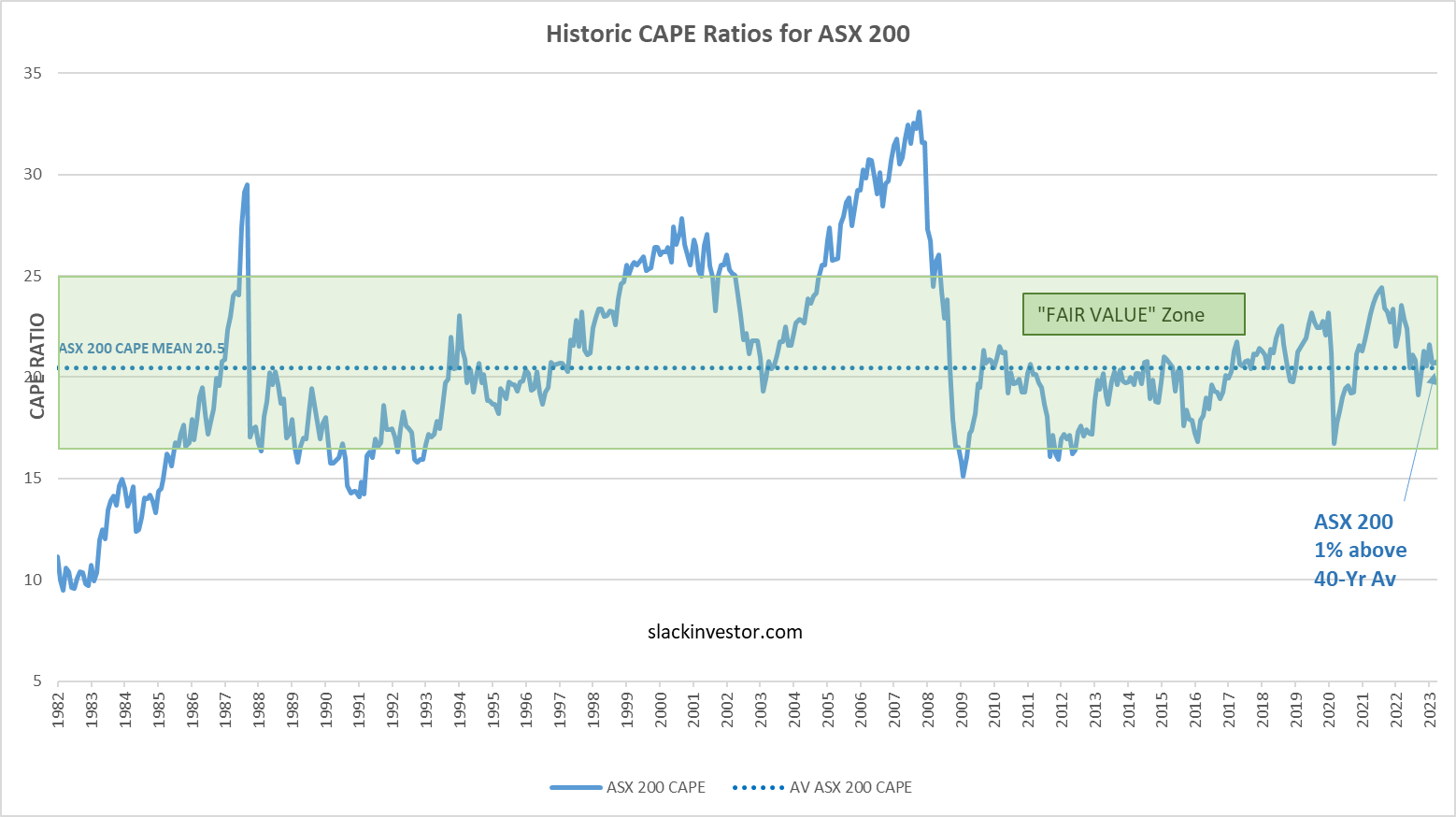
For the following charts, Slack Investor uses monthly CAPE data from Barclays, the 40-yr mean is calculated and plotted together with the latest actual CAPE values up until 31 October 2025. A ‘fair value’ zone is created in green where the CAPE is within one standard deviation of the mean (average) – click images for better resolution.

ASX 200 CAPE Value 22.89 (11% above long-term av.)

ASX CAPE values – up to 31 October 2025

FTSE 100 CAPE Value 18.24 (5% above long-term av.)

UK CAPE values – up to 31 October 2025

S&P 500 CAPE Value 39.76 (59% above long-term av.)

US CAPE values – up to 31 October 2025

The UK and Australian markets are not too overvalued. However, in terms of the Shiller P/E the S&P 500 has entered some lofty territory. Unfortunately, whenever the S&P 500 has a large correction the effects are usually felt in other markets.

There is some good research that links CAPE to long-term returns … and future returns are what gets Slack Investor excited. The predictive skill of the Schiller CAPE is not very good over 1-yr and 5-yr periods. However, it does show some skill for periods of 10 years and longer. The tight spread around the trend line indicates that the Shiller P/E might have some predictive skill.

Shiller P/E and S&P 500 10-year annualised forward returns since 1983. The data shows 41 years of S&P 500 10-year average annual returns based upon the Shiller PE ratio (from 10 years ago). Slack Investor has modified the chart and circled the 10-year average returns based upon the times when the Shiller P/E was previously around 40 – From Invesco.com

If this relationship holds, the average S&P 500 10-year annualised forward returns are predicted to be close to zero or negative. This indicates that now is not a good time to start buying the S&P 500. Tech stocks (with high P/E) have fallen sharply lately and this could be early signs of a readjustment.

Slack Investor is not one with predictive skills. He just plods along – staying mostly invested and knowing that he has his stable income pile to ride out any market gyrations. Cripes … even the great Warren Buffet’s Berkshire Hathaway stock had 11 negative years between 1965 to 2024. Slack Investor could only dream of emulating the Buff’s long term compounded annual return of 19.9% over 55 years.

Ride that Horse! – October 2025 End of Month Update

Calgary Sun

Slack Investor reads a lot of finance news each week. Sadly, there now seems to be a portion of the finance news that seems to come from AI sources. However, there is still a lot of good stuff by real people – and he came across an excellent article by Carl Capolingua that had some great investor truths that apply to the current market.

A disciplined investor doesn’t fight the market – they respect it. They accept the market is responsible for their investing outcomes, win, lose or draw. They also accept that they have absolutely no control over the market or the outcomes it delivers. – Carl Capolingua, Livewire Markets

The original article focuses on the difficulty of letting go of investments that have shown a loss. Slack Investor is still searching for this zen state and has written about his own troubles with selling stocks that have had a sudden fall. However, the quote above sums up ‘the bargain’ that Slack Investor has made with stocks and their volatility. I don’t know when the next correction (or worse!) is coming … but I know it’s coming.

World Markets are Expensive at the Moment

Although Slack Investor collects his own data on relative market value using CAPE numbers, the remarkable Ashley Owen has produced a great graphic showing the relative size of the world markets and how expensive they are at the moment in terms of PE and Yield. Clearly, the US market looks over ripe and any corrections here will historically influence all other markets.

World markets plotted by PE Ratio and Yield – From the very erudite Ashley Owen of Owen Analytics

Short-term Returns are Volatile

The chart below shows that the S&P 500 returns for a calendar year are all over the place, but if you just hung on, and didn’t sell the S&P 500 when times were tough, you would be rewarded with an average annual return of 12.2% over 30 years. Not Bad. Australian shares have returned an average yearly gain of 11.5% from 1900 to 2020.

Yearly Returns of the S&P 500 (green columns) and 15-yr rolling returns (blue line) – From T. RowePrice

What to do when the Correction comes

‘If you have trouble imagining a 20% loss in the stock market, you shouldn’t be in stocks.Vanguard founder – John C. Bogle

Slack Investor has had no real luck in timing the markets – despite a disciplined 21-yr project trying to do this. There are those that can, Marcus Padley and his investment team have gone to 100% cash and reported this on 21 October 2025. Slack Investor hasn’t the knowledge, or gumption, to confidently predict market exits and entries – and yet, has done OK in the investing business without too much angst.

Slack Investor knows that for an ordinary person, the stock market is the place with best long-term returns with minimal transaction costs. The bargain – to accept volatility in return for long-term gains – is accepted.

  • He has his stable income pile to keep the dogs from the door.
  • He tinkers with his Investment Portfolio of predominantly growth shares, but mostly he leaves it alone.
  • He will not sell his shares after a correction and convert to cash.
  • He has elevated his cash position slightly (6% cash, 94% invested) in case some bargains come up post-correction.

These are choppy times and there is an uncertain near-term future – situation normal in the stock market. Some of his portfolio (e.g. CSL, WTC, TLX) have had big falls lately. However, Slack Investor has had a look at future revenue predictions and has not completely given up on these stocks. Though, CSL is losing its shine as a growth company in Slack Investor terms.

He will keep riding that stock market horse … and push to the forefront of his mind the pleasant times at the rodeo bar with his cowboy mates … reflecting on our glorious achievements.

October 2025 – End of Month Update

Slack Investor is IN for Australian index shares, the US Index S&P 500 and the FTSE 100.

The S&P 500 (+2.3%) and the FTSE 100 (+3.9%) have continued their strong monthly growth. Slack Investor is pleased to stay on board but there he remains nervous about the US markets. For the ASX 200, (+0.4%) a flat month with plenty of volatility.

All Index pages and charts have been updated to reflect the monthly changes – (ASX IndexUK IndexUS Index).

Battle of the Tech Titans

Thank you Perplexity AI for creating this engrossing image.

Amongst the usual Trump horror stories, a news item emerged from the US that grabbed Slack Investor’s eye.

NVIDIA made history by becoming the world’s first publicly traded company to surpass a $4 trillion market capitalization. – USA Today

This made me wonder about the other US Companies that are now really big and worth a lot of money. It is no surprise that the top 5 are all tech companies.

CompanyMarket Cap (USD)
NVIDIA$4.00 trillion
Microsoft$3.75 trillion
Apple$3.20 trillion
Amazon$2.38 trillion
Alphabet$2.18 trillion

NVIDIA has only been around since 1993 and Slack Investor can remember buying their top range Graphic Processing Units (GPU) when he was looking to improve his home PC. The company has really moved on and started its growth spurt when they decided to design chips and software platforms specifically for Artificial Intelligence (AI). NVIDIA chips and networks are used extensively for AI development and training – and the world is crying out for these products to deal with complex AI workloads.

Dangers of current US Market

US Stock market valuation as at July 5, 2025 – The Patient Investor

According to the Shiller PE , Buffet Indicator, and a range of other measures, the US market is overvalued. Slack investor has even considered deploying his US funds elsewhere. But, amongst the vast array of US choice, there are still companies that will do well – whatever the conditions. Slack Investor has almost 14% of his portfolio in Alphabet shares and, this might be a case of too many eggs in the one basket.
Alphabet is a great company and has done well for Slack Investor but recent developments make him think that their dominance may be slipping as it faces new competitors.

Also, there are a few annoying things that are starting to bother Slack Investor about some Alphabet products. This is tricky … as a share owner, I like my companies to make money but, it is a balance – you don’t want to kill the golden goose!

  • Youtube – what a killer application! However, the amount of ads starting to creep into Youtube videos has started to destroy the experience for Slack Investor.
  • Google Search – has long been my go to search engine, but the dominance of sponsored links and cluttered feel has made Slack Investor start to look at other search providers. The recent prominence of the Google search AI summary is a good step to help compete with the alternatives.

Alphabet is a conglomerate of many great businesses and my whinging about a couple of their products is just nit-picking – thank you Spinal Tap! However, Google search and Youtube ads are important to Alphabet and contribute 67% of total revenue (2024) – both of these businesses are under competitive pressure.

Perplexity

Thanks to a suggestion by Trevor, a keen reader of the blog, Slack Investor has been exploring a new AI based search engine – Perplexity. He is liking what he is seeing so far and using it more and more to search the web. It has a refreshingly simple interface and can be used via an app or a web page (https://www.perplexity.ai).

So far, it has been very useful for even complex tasks. Yesterday, I asked Perplexity to find me a ‘package holiday for Australian travellers that includes 3 nights in Bangkok and 4 nights at a beach resort’ – the results were on point! Further, NVIDIA is backing Perplexity and has just launched an AI-powered browser to challenge Google Chrome.

Time to take a look at this NVIDIA company in a Slack way.

NVIDIA (NVDA.NASDAQ) vs Alphabet (GOOGL.NASDAQ)

Both are big growing tech companies in different parts of the industry. It’s too hard for Slack Investor to look at everything so he will just condense it down to numbers that he can understand. The excellent finance resource Market Screener was used to get the statistics. Where PE (2027/8) is the predicted Price Earnings ratio for 2027/8, ROE is the predicted Return on Equity for 2027, EPS Growth (av) is the average of projected earnings annual growth 2025-2027, and the Slack Factor combines all of these metrics into one number – the higher number the better!

NameSymbolPE (2027/8)ROE (2027)EPS GROWTH (AV)SLACK FACTOR
NVIDEA Corp (US)NVDA26.3572962
Alphabet (US)GOOGL15.2261323

Although Alphabet is still projected to be a growing company, it seems that the growth may be slowing. NVIDIA is currently in the spectacular growth stage and Slack Investor wants to be part of it.

It is not cheap (PE 2025 = 53; Forecast PE 2028 = 26 ) … but great companies seldom are. After some compulsory Tour de France viewing, I stayed up late last night to access the US markets to sell some GOOGL and buy NVDA. After the NVDA purchase, respectively, they are now 5% and 9% of my investment portfolio.

Market Value – April 2025 Update

Slack Investor is enjoying the relative calm in the markets over these past couple of days. It is a good time to update the charts for the Cyclically Adjusted Price to Earnings ratios (CAPE). He first started using CAPE as a ‘value’ tool in September 2021 and, the most recent post on Market Value was for the end of December 2024. That feels like such a long time ago – pre-Donald 2.0. The markets have been on quite a ride since then.

There is some good research that links CAPE to long-term returns … and future returns are what gets Slack Investor excited. The predictive skill of the Schiller CAPE is not very good over 1-yr and 5-yr periods. However, it does show some skill for periods of 10 years and longer.

Shiller P/E and S&P 500 10-year annualised forward returns from 1983. There is a clear relationship between higher CAPE and lower expected 10-yr returns for the S&P 500. Data valid as of 31 December 2023 – Investco

Research Affiliates

For the following charts, Slack Investor uses monthly CAPE data from Barclays, the 40-yr mean is calculated and plotted together with the latest CAPE values – estimated up until 14 April 2025. A ‘fair value’ zone is created in green where the CAPE is within one standard deviation of the mean (average) – click images for better resolution.

ASX 200 CAPE Value – 3% above long-term av.

ASX CAPE values – estimated up until April 14 2025

FTSE 100 CAPE Value – 10% below long-term av.

UK CAPE values – estimated up until April 14 2025

S&P 500 CAPE Value – 32% above long-term av.

US CAPE values – estimated up until April 14 2025

Market value and Market Timing Experiment

The ASX 200 and the FTSE 100 are both within 10% of their 40-yr CAPE average. When within the green ‘fair value’ range, Slack Investor has patience and he will be assessing these charts at the end of the month.

The US index chart was, and still is, above the ‘fair value’ range and Slack investor had the S&P 500 on a weekly check. Last week it plunged below the stop loss and Slack Investor sold. These are early days in the Trump 2.0 experience – given current form, there will be more surprises.

The US Index is just a small part of the Slack Portfolio (1.6%). The bulk of his portfolio is currently riding the market roller coaster – patiently in search of long-term returns.

Market Timing Experiment – Update

Apologies for intruding into your inbox. I like to keep the Slack Investor blog folly to twice a month. But these are unusual times.

The Slack Investor Market Timing Experiment

Slack Investor started his ‘index-timing’ strategy in 2004 with the ASX IndexUK IndexUS Index. An earlier version of Slack Investor thought that by monitoring the market at weekly and monthly intervals and setting ‘stop losses’ to know when to sell the index. To know when to buy, he used a momentum indicator called the Directional Movement Index.

Although, there was some initial success over the ‘buy and hold’ strategy, the benefits work out to be quite small on a yearly basis. For example, for the Australian Index there is a 1.2% p.a. outperformance for Slack market timing strategy over ‘buy and hold’.

These relatively small gains would have probably been offset by earned share dividends if I was using the alternative ‘buy and hold’ strategy. Market timing works well when there are sustained periods of bull and bear markets and the changes between the two are not too rapid. The short transitions and the speed of market fluctuations in the last 20 years has forced a bit of a rethink on Slack Investor’s timing the markets strategy.

Instead of monitoring the markets monthly, he has been looking for weekly changes as well. He is also taking the current market value and recent trends into account. Slack Investor is a man of routine and he has now decided to keep the experiment going for 25 years (till 2029). After this, he will probably go for the more appropriate Slack Investor method of doing nothing and adopting a ‘buy and hold’ technique for index funds (ASX IndexUK IndexUS Index).

US Index – Slack Investor is OUT

Monthly chart S&P 500 up until Friday April 4 2023 – incrediblecharts.com

At the end of the past week, Slack Investor conducted a review of the Index charts and noted that the US Index price has slipped below the stop loss (thick red line). As the trend is still downward, and the market is overvalued (see below), it is time to get out. As part of this experiment, I will sell my small holding of S&P 500 Index tomorrow and update the US Index page.

US CAPE values – up till the end of March 2025 showing the index is still overvalued (at March 31). The CAPE ratio is above the green zone.

What about the rest of the Slack Portfolio?

Deep down, Slack Investor doesn’t believe he is very good at timing the markets. The bulk of the Slack Portfolio (97%) is not in index funds, but in growth companies – that are taking a bit of a beating at the moment. That’s what the stock market does in times of uncertainty.

Mostly, Slack Investor will be doing nothing. He will try and distract himself from the self-destructing behaviour of Trump. I cannot remember a time where the whole world was so united in its resolve against the USA. Slack Investor knows that good times (and prices) will return. Slack Investor has his Stable Income Portfolio if he needs cash.

The worst thing to do, from a long-term wealth perspective, is to convert shares to cash in a down market – Slack Investor (and other wise investors!)

On the back burner is my project to sell some of the Slack Investor owned companies with a relatively low Slack Factor – and invest more in those with a high Slack Factor.

Market Value – December 2024 Update

A few times a year, Slack Investor likes to take a snapshot of the markets using the Cyclically Adjusted Price to Earnings ratios (CAPE) – which use ten-year average inflation-adjusted earnings. He first started using CAPE as a ‘value’ tool in September 2021 and, the most recent post on Market Value was for the end of May 2024. That was 6 months ago and, probably due to the strange ‘Donald 2.0’ effect, the US and Australian markets have powered on since then.

There are some critics of CAPE as a predictive tool. However, there is some good research that links CAPE to future returns … and future returns are what Slack Investor is all about.

Shiller P/E and S&P 500 10-year annualised forward returns from 1983. There is a clear relationship between higher CAPE and lower expected 10-yr returns for the S&P 500. Data valid as of 31 December 2023 – Investco

The CAPE (cyclically adjusted PE) ratio is not a useful timing signal for market turning points, but is a powerful predictor of long-term market returns.

Research Affiliates

For the following charts, Slack Investor uses monthly CAPE data from Barclays, the 40-yr mean is calculated and plotted together with the latest CAPE values – up till the end of November 2024. A ‘fair value’ zone is created in green where the CAPE is within one standard deviation of the mean (average) – click images for better resolution.

ASX 200 CAPE Value 23.0 (12% above long-term av.)

ASX CAPE values – up till the end of November 2024

FTSE 100 CAPE Value 16.3 (7% below long-term av.)

UK CAPE values – up till the end of November 2024

S&P 500 CAPE Value 37.7 (52% above long-term av.)

US CAPE values – up till the end of November 2024

What is Slack Investor doing about the high US market values?

Not much. The predictive skill of the Schiller CAPE is not very good over 1-yr and 5-yr periods. It does show some skill for periods of 10 years and longer. This poses the question – should he withdraw his investments and just wait out the next ten years? Not likely! Time in the market is what matters.

The CAPE ratio is a helpful way for Slack Investor to look at the current state of the markets – it doesn’t change his approach to investing. He will just stick to his guns with his tried and true investment strategy.

  • Invest in a range of companies using ETF’s or a portfolio of at least 15 stocks.
  • For the individual stocks, continually monitor these investments to make sure that they still have some competitive advantages (e.g. A Moat), generate sustainable profits, they are continuing to grow and predicted to grow further.

These type of companies should do OK over most market cycles.

Slack Greetings from the UK – an ode to English Pubs

Slack Investor is not really much of a cold season traveller but he is here in the UK for some family business. England in winter is pretty grim with short days and cold weather. However, there is joy in slipping into a great English pub with a fire going and conversation everywhere. Experience tells me that most English pubs are good. But, he wasn’t just in any pub – Slack Investor was drinking at the RAF bar of The Eagle in Cambridge. Famous for being the pub where Francis Crick and James Watson (based on the work of Rosalind Franklin and others) celebrated and announced the double helix structure of DNA in 1953. Long live the English Pub.

The Eagle, Cambridge, UK. Long live the English Pub.

Market Value – End of May 2024 … and Travel Navigation

The Jeweller’s Bounty (1918)Daniel Cortes

A few times a year, Slack Investor likes to take a snapshot of the markets using the Cyclically Adjusted Price to Earnings ratios (CAPE) which use ten-year average inflation-adjusted earnings. I first started using CAPE as a “value” tool in September 2021 and, my most recent look was for the end of January 2024. I have decided to do this CAPE market value analysis every few months.

Jeremy Grantham is a well known and astute investor and he argues that recent globalization has benefited the profitability of US companies and that their is good reason for an increasing CAPE trend in the US markets. However, there is some good research that links CAPE to future returns.

The CAPE (cyclically adjusted PE) ratio is not a useful timing signal for market turning points, but is a powerful predictor of long-term market returns

Research Affiliates

By plotting this CAPE over a period of time, we can look at how the whole sharemarket is currently valued in terms of historical data – this way we can track the whole share market as it oscillates between overvalued and undervalued. According to Research Affiliates, CAPE offers a negative correlation with subsequent 10-year and 20-year stock market returns – the higher the current CAPE, the lower are the expected future returns.

For the following charts, I use monthly CAPE data from Barclays, the 40-yr mean is calculated and plotted together with the latest CAPE values – up till the end of May 2024. A “fair value” zone is created in green where the CAPE is within one standard deviation of the mean (average) – click images for better resolution.

The US market remains the outlier here at 37% above its long-term value. Slack Investor is no guru, but, it doesn’t make sense to him to invest new money into a “frothy” whole-market index like the S&P 500 – at the moment!

ASX 200 Value (4% above long-term value)

FTSE 100 Value (4% below long-term value)

S&P 500 Value (37% above long-term value)

Slack Greetings from Provence – plus Navigational Tips

Evening view of the Luberon Valley, from Bonnieux, Provence. France

Slack Investor is in Europe at the moment (Boo … Hiss!), I have just finished a walking holiday in Provence, France. All I can say is that – it is a beautiful part of the world.

Steeped in history and preserved in that remarkable French way that respects the past. We moved around the intricate roads and paths using a fantastic bit of Android/IOS/Windows software called Komoot. The software is free to download on your phone with one local region – and, I added world maps for a one-time lifetime fee of $30 USD about 10 years ago – It was the best money I have ever spent, as I use the app daily. You can plot “tours” that are based upon the comprehensive “Open Street Maps” network which lists all the tiny paths and tracks that rarely appear in Google Maps. The output is best used on your phone – but the app is easier to plan using the desktop version of your Komoot account. I have no financial interest in any of the products that Slack Investor sometimes rambles on about.

Google Maps output for the area 5km east of Gordes, Provence, France – great for roads and business locations
Komoot output for the area 5km east of Gordes, Provence, France – Great for smaller roads and footpaths (tracks). The footpaths are shown as black lines and the blue line is our journey out from Gordes on the way to Roussillon.

Market Value – February 2024

The Jeweller’s Bounty (1918)Daniel Cortes

A few times a year, Slack Investor likes to take a snapshot of the markets using the Cyclically Adjusted Price to Earnings ratios (CAPE) which use ten-year average inflation-adjusted earnings. I first started using CAPE as a “value” tool in September 2021 and, my most recent look was in mid-November 2023. I have decided to do this CAPE market value analysis every 3 months – as I like to keep a feel of where we are – as the market cycles. The next update will be in mid-May 2024.

By plotting this CAPE over a period of time, we can look at how the whole sharemarket is currently valued in terms of historical data – this way we can track the whole share market as it oscillates between overvalued and undervalued.

Using monthly CAPE data from Barclays, the 40-yr mean is calculated and plotted together with the CAPE values. A “fair value” zone is created in green where the CAPE is within one standard deviation of the mean (average).

ASX 200 Value

Historic CAPE ratios for the ASX 200 – From 1982 to end of January 2024 – Click the chart for better resolution.

FTSE 100 Value

Historic CAPE ratios for the FTSE 100 – From 1982 to end of January 2024– Click the chart for better resolution.

S&P 500 Value

Historic CAPE ratios for the S&P 500 – From 1982 to end of January 2024 – Click the chart for better resolution.

At the end of January 2023, the FTSE 100 (11% below the 40-yr average) is the only followed market “ON SALE”. I love a price reduction!

The ASX 100 (4% above the 40-yr average) is in the “Fair Value” zone. However, the S&P 500 still looks well overvalued at 32% above the 40-yr average – and has just moved above the “Fair Value” zone.