The ‘Wedgie’ is Back!

Slack Investor is delighted to report that the ‘Wedgie’ has returned. The ‘Wedgie’ is a chart pattern that is less entertainingly called the ‘breaking a long-term downtrendline’. Looking for chart patterns can be confusing and belongs to the ‘dark art’ world of technical analysis. However, Slack Investor has some faith in the ‘Wedgie’. The chart pattern was first discussed by Slack Investor back in 2019 and he has done a small-scale analysis on whether it works 1-yr on. His conclusion, yes, mostly!

The top of the wedge downtrend line should be drawn for a period of at least 3 months (preferably 6 months) and connect at least 2 (and preferably 3) descending high points. – Slack Investor

Telix Pharma (TLX.AX) weekly chart showing the ‘Wedgie’ in blue and the price bars breaking out of the ‘Wedgie’ – incrediblecharts.com

There is a reason why I think it works. Firstly, there is a long-term decline in price, usually because of some bad news in reporting season. Then there comes a point when the market starts thinking that things have gone too far … the stock is relatively cheap … and people start buying the stock again. Slack Investor likes owning stocks that other people want. The price has a real reason to increase.

It brings some pain to Slack Investor to revisit the chart above as Telix Pharmaceuticals (TLX.AX) has been one of his biggest losers this financial year. He should have got out much sooner! But, to Slack Investor’s credit, he will try to judge this case without hard feelings – as the breakout from the downtrend looks to be quite strong.

Naturally, having been burnt once on TLX, he revisits the important numbers from Market Screener Finance. There are a number of traits that Slack Investor looks for before investing in a company. A good summary can be found here with the definitions of the Slack Factor and Slack Ratio. As a rule of thumb, Slack Investor likes the Slack Ratio to be greater than 0.7 and the Slack Factor to be greater than 10. For TLX, the Slack Ratio is below this – but I have bought a parcel of shares anyway on account of the strong projected annual growth (greater than 100% p.a.). Note: for all his Slack Factor calculations he limits the projected growth to 30% p.a. to try to avoid the far too heroic forecasts.

Due to past disapointments, he will be keeping a close eye on TLX but the recent regulatory hurdles for their products seem to have been mostly cleared. Slack Investor is heartened by the recently announced collaboration deal with Regeneron Pharmaceuticals Inc (NASDAQ: REGN).

The ‘Wedgie’ below for NDQ says it was time for Slack Investor to also enter the NASDAQ 100 again via the Betashares Nasdaq 100 ETF (NDQ.AX). I like being involved with the 100 largest tech companies in the US. This index really aligns with innovation and growth. There are similar ‘Wedgie’ outbreaks on some of Slack Investor favourite companies – PME and TNE.

Betashares Nasdaq 100 ETF (NDQ.AX) weekly chart showing the ‘Wedgie’ in blue and the price bars breaking out of the ‘Wedgie’ – incrediblecharts.com

Sitting

Similar patterns are beginning to show on my weekly review of the charts of stocks in the Slack Portfolio. Slack Investor also looks at stocks that he would like in the portfolio that may have got caught in a downtrend – and have recently shown signs of positive momentum. Of course, with the ‘Orange Buffoon’ still in a powerful position – anything could happen! But this won’t stop me from investing in good companies.

“You don’t make money by trading, you make it by sitting.”
― Fred McAllen, Charting and Technical Analysis

CAR Group (CAR.AX) weekly chart showing the ‘Wedgie’ in blue and the price bars hopefully breaking out of the ‘Wedgie’ soon. – incrediblecharts.com

Slack Investor is patiently sitting with a bit of cash and hopes to take advantage of any further ‘Wedgie’ opportunities that present themselves. In addition to CAR, the ‘Wedgie’ is in its pre-breakout form for companies with prospects such as WTC, GMG, REA, SNL and XRO.

Slack Portfolio Surgery – February 2026 End of Month Update

Robert Liston operating. Painting by Ernest Board of Bristol (1877-1934) – Wikimedia Commons

The leg amputation depicted above was supposedly done in under 30 seconds. Dr Liston not only managed to kill the patient (Sepsis), but one of his assistants (Sepsis) – and also one of the audience (shock). A 300% mortality rate! Slack Investor hopes for a better outcome after some recent portfolio surgery.

SaaS-pocalypse

The ‘SaaS-pocalypse’, a trending term to describe the recent and dramatic sell-off in global Software-as-a-Service (SaaS) shares, is based on the idea that AI becomes so advanced that software becomes redundant. – The Guardian

Slack Investor went into a bit of detail last post on the sell off in tech and healthcare stocks due to the release of AI tools such as Claude. This wasn’t just some tale in a distant land, the ‘SaaS-pocalypse’ was having a very direct affect on the Slack Portfolio.

ASX200 biggest falls since August 2025 (Data as of 4/2/2026) – Livewire

Is this really a disaster for the Slack Portfolio? Slack Investor prides himself on getting things ‘mostly right’. However, this 2026 Financial Year has been testing – it seems that he has been getting things ‘mostly wrong’! However, Slack Investor knows that only long-term results count.

It is certainly a setback, as Slack Investor has attached himself to 5 of these ‘Biggest Fall’ ASX companies set out above. Some remedial action is required.

Slack Investor has been in this game long enough to not panic. He has however given the Slack Portfolio a ‘very hard look’ and has been gradually building up his cash position by selling companies that have not a convincing story to tell in these frothy times – particularly those with an extended PE Ratio. Future incomes may not be enough to justify their expense (high PE Ratio). He is mindful that the recent sell-off might be overdone in some cases.

But the companies being indiscriminately sold are often those whose actual protection was never in the codebase to begin with. The durable moats live outside the software entirely, in proprietary data rights, regulatory licences, institutional relationships, deep workflow embedding, and sustained frontier research. None of these can be prompt-engineered into existence. – Mark Gardner, MPC Markets –Livewire

Since his last published quarterly portfolio, Slack Investor has reduced his exposure to the US market (Sold NVDA, NDQ, JNDQ) and sold off some of his more speculative holdings (TLX, MP1 and CXL). His cash position is healthy and waiting for some future opportunities. His Stable Income pile plus Slack Portfolio dividends are enough for living expenses and holidays. Slack Investor should never be forced into a sale of his stocks.

Rules of thumb when bad things happen

Slack Investor has general rules of thumb for when stock prices have a fall of 20%. These questions must be asked.

  • Has something fundamentally changed with the company? Such as sustained falling earnings, new competitors, etc.
  • After running the numbers for predicted PE Ratio, predicted ROE and predicted growth. Would Slack Investor buy this company at the current price?

As well, for SaaS stocks, Slack Investor has another question.

  • Does the company produce proprietary software and embedded relationships with its clients that would provide a durable moat?

These three questions were enough for me to hang on to my battered software-based stocks TNE, CAR, REA, and WTC – and hope for a recovery.

February 2026 – End of Month Update

Slack Investor remains IN for Australian index shares, the US Index S&P 500 and the FTSE 100.

Despite the turbulence in the Slack Portfolio, it was a good month for the ASX 200 (+3.7%). The FTSE 100 is in record territory with 6.7% February growth. A well deserved rest for the US markets (S&P 500: -0.9%).

All Index pages and charts have been updated to reflect the monthly changes – (ASX IndexUK IndexUS Index).

Warren Buffet and Market Value – November 2025 Update

Warren Buffet and his offsider the late Charlie Munger are dead set Slack Investor Heroes – and a reminder that the USA offers a crucible for outstanding qualities to emerge in individuals – as well as, in some presidential types, some not so good qualities. Mr Buffet is a great investor and philanthropist and full of insightful but humble advice that is worth heeding. Every November he writes a letter to his Berkshire Hathaway shareholders and it is a delight to read in full. This will be his last shareholder letter as he is retiring at the grand age of 95.

‘Our stock price will move capriciously, occasionally falling 50% or so as has happened three times in 60 years under present management. Don’t despair; America will come back and so will Berkshire shares.’ – Berkshire Hathaway 2025 Newsletter

Even investors as great as Warren Buffet are not immune to large market swings. After all, it is your long-term performance that is the most critical for a lifetime investor.

‘Since 1965, shares of Warren Buffett’s conglomerate, Berkshire Hathaway (BRK.B), have delivered a compounded annual return of 19.9% — almost double that of the S&P 500 over the same period.’ Investopedia using data from the Berkshire Hathaway 2024 Newsletter

Warren Buffet liked to look at current market valuation (S&P 500) as a ratio with the current US Gross Domestic Product (GDP). At 30 June 2025 the ratio was 217%. A long way above the trend line and a warning that the S&P 500 was growing at a rate much faster than the general economy – this is a danger sign.

The Buffet Indicator is the ratio of the total United States stock market to GDP. The ratio is now two standard deviations away from the historical trend line – from Current Market Valuation

Market Value – November 2025 Update

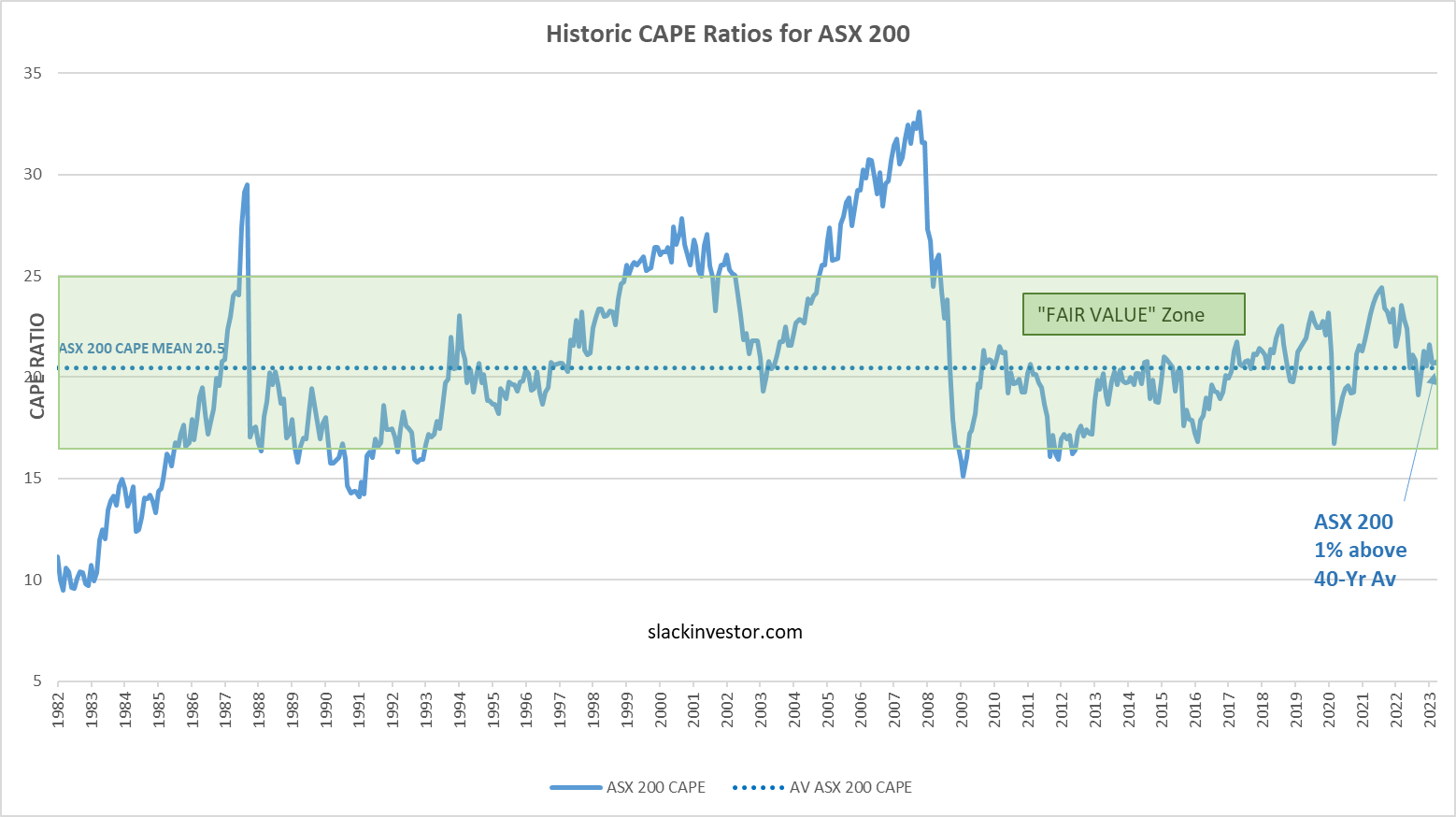
Slack Investor also likes to keep up to date with how the markets are travelling for value and he has been using charts for the Cyclically Adjusted Price to Earnings ratios (CAPE). This value is also known as the Shiller P/E Ratio after Robert Shiller the economics professor that made this measure popular. Slack Investor first started using CAPE as a ‘value’ tool in September 2021. The most recent post on Market Value was mid-April 2025 about 6 months ago.

For the following charts, Slack Investor uses monthly CAPE data from Barclays, the 40-yr mean is calculated and plotted together with the latest actual CAPE values up until 31 October 2025. A ‘fair value’ zone is created in green where the CAPE is within one standard deviation of the mean (average) – click images for better resolution.

ASX 200 CAPE Value 22.89 (11% above long-term av.)

ASX CAPE values – up to 31 October 2025

FTSE 100 CAPE Value 18.24 (5% above long-term av.)

UK CAPE values – up to 31 October 2025

S&P 500 CAPE Value 39.76 (59% above long-term av.)

US CAPE values – up to 31 October 2025

The UK and Australian markets are not too overvalued. However, in terms of the Shiller P/E the S&P 500 has entered some lofty territory. Unfortunately, whenever the S&P 500 has a large correction the effects are usually felt in other markets.

There is some good research that links CAPE to long-term returns … and future returns are what gets Slack Investor excited. The predictive skill of the Schiller CAPE is not very good over 1-yr and 5-yr periods. However, it does show some skill for periods of 10 years and longer. The tight spread around the trend line indicates that the Shiller P/E might have some predictive skill.

Shiller P/E and S&P 500 10-year annualised forward returns since 1983. The data shows 41 years of S&P 500 10-year average annual returns based upon the Shiller PE ratio (from 10 years ago). Slack Investor has modified the chart and circled the 10-year average returns based upon the times when the Shiller P/E was previously around 40 – From Invesco.com

If this relationship holds, the average S&P 500 10-year annualised forward returns are predicted to be close to zero or negative. This indicates that now is not a good time to start buying the S&P 500. Tech stocks (with high P/E) have fallen sharply lately and this could be early signs of a readjustment.

Slack Investor is not one with predictive skills. He just plods along – staying mostly invested and knowing that he has his stable income pile to ride out any market gyrations. Cripes … even the great Warren Buffet’s Berkshire Hathaway stock had 11 negative years between 1965 to 2024. Slack Investor could only dream of emulating the Buff’s long term compounded annual return of 19.9% over 55 years.

Ride that Horse! – October 2025 End of Month Update

Calgary Sun

Slack Investor reads a lot of finance news each week. Sadly, there now seems to be a portion of the finance news that seems to come from AI sources. However, there is still a lot of good stuff by real people – and he came across an excellent article by Carl Capolingua that had some great investor truths that apply to the current market.

A disciplined investor doesn’t fight the market – they respect it. They accept the market is responsible for their investing outcomes, win, lose or draw. They also accept that they have absolutely no control over the market or the outcomes it delivers. – Carl Capolingua, Livewire Markets

The original article focuses on the difficulty of letting go of investments that have shown a loss. Slack Investor is still searching for this zen state and has written about his own troubles with selling stocks that have had a sudden fall. However, the quote above sums up ‘the bargain’ that Slack Investor has made with stocks and their volatility. I don’t know when the next correction (or worse!) is coming … but I know it’s coming.

World Markets are Expensive at the Moment

Although Slack Investor collects his own data on relative market value using CAPE numbers, the remarkable Ashley Owen has produced a great graphic showing the relative size of the world markets and how expensive they are at the moment in terms of PE and Yield. Clearly, the US market looks over ripe and any corrections here will historically influence all other markets.

World markets plotted by PE Ratio and Yield – From the very erudite Ashley Owen of Owen Analytics

Short-term Returns are Volatile

The chart below shows that the S&P 500 returns for a calendar year are all over the place, but if you just hung on, and didn’t sell the S&P 500 when times were tough, you would be rewarded with an average annual return of 12.2% over 30 years. Not Bad. Australian shares have returned an average yearly gain of 11.5% from 1900 to 2020.

Yearly Returns of the S&P 500 (green columns) and 15-yr rolling returns (blue line) – From T. RowePrice

What to do when the Correction comes

‘If you have trouble imagining a 20% loss in the stock market, you shouldn’t be in stocks.Vanguard founder – John C. Bogle

Slack Investor has had no real luck in timing the markets – despite a disciplined 21-yr project trying to do this. There are those that can, Marcus Padley and his investment team have gone to 100% cash and reported this on 21 October 2025. Slack Investor hasn’t the knowledge, or gumption, to confidently predict market exits and entries – and yet, has done OK in the investing business without too much angst.

Slack Investor knows that for an ordinary person, the stock market is the place with best long-term returns with minimal transaction costs. The bargain – to accept volatility in return for long-term gains – is accepted.

  • He has his stable income pile to keep the dogs from the door.
  • He tinkers with his Investment Portfolio of predominantly growth shares, but mostly he leaves it alone.
  • He will not sell his shares after a correction and convert to cash.
  • He has elevated his cash position slightly (6% cash, 94% invested) in case some bargains come up post-correction.

These are choppy times and there is an uncertain near-term future – situation normal in the stock market. Some of his portfolio (e.g. CSL, WTC, TLX) have had big falls lately. However, Slack Investor has had a look at future revenue predictions and has not completely given up on these stocks. Though, CSL is losing its shine as a growth company in Slack Investor terms.

He will keep riding that stock market horse … and push to the forefront of his mind the pleasant times at the rodeo bar with his cowboy mates … reflecting on our glorious achievements.

October 2025 – End of Month Update

Slack Investor is IN for Australian index shares, the US Index S&P 500 and the FTSE 100.

The S&P 500 (+2.3%) and the FTSE 100 (+3.9%) have continued their strong monthly growth. Slack Investor is pleased to stay on board but there he remains nervous about the US markets. For the ASX 200, (+0.4%) a flat month with plenty of volatility.

All Index pages and charts have been updated to reflect the monthly changes – (ASX IndexUK IndexUS Index).

Hubris

noun
  1. pride or arrogance
  2. (in Greek tragedy) an excess of ambition, pride, etc, ultimately causing the transgressor’s ruin.

Slack Investor possesses all the human frailties – try as he might, even after decades of investing, some of these failings will occasionally surface. Recently flushed with pride with his good performance figures for the past 15 years, he let a few stock plunges go too far – on the mistaken premise that the market will quickly correct itself to reinforce Slack Investor’s view of the world.

A bit of history here … Slack Investor is disciplined in his investing in many ways. However, a trait that he struggles to shake is the sin of hubris. So convinced is Slack Investor of his magnificent stock picking abilities – he sometimes will persuade his inner self that, after a stock price fall, the ‘market’ has got this one wrong! He was so happy while his healthcare stock prices were going up that he brushed aside the unmistakable signs of decline over the past 6 months.

Slack Investor waded into Telix Pharma last year on the strength of its very impressive projected growth figures which led to a very high Slack Factor score. What he didn’t account for is the huge effect of any regulatory problems on potential growth. During reporting season, just the suggestion of problems with the regulators causes great panic.

The Telix share price plunged 18.8% on the day after the company revealed it had run into a snag with the United States Food and Drug Administration (FDA). From Motley Fool, reporting on just one of the TLX shocks that has led to a 30% stock price drop in August 2025.

With hindsight, Slack Investor wishes he had acted more quickly with his stop loss levels, but the falls were so dramatic that only the day traders would be able to get out with some dignity. Slack Investor is not a day trader and looks at his stocks weekly.

What to do about Telix now?

The FDA concerns with TLX were about some future products in the pipeline and the actual 2025 reporting season results were quite goodhopefully, all the bad news is already priced in! It is time to rationally have another look at the stock to decide whether to dump TLX and look for other opportunities. I go to the Market Screener Finance tab for TLX.

Slack Investor first looks at the Income/Projected Income chart to ensure that the income over the past few years and the projected income are showing a rising trend. The next chart down is the Balance sheet. He is looking for debt levels that are well covered by sales. No red flags here.

He then collects a few numbers. PE levels at 170 (December 2024) are frighteningly high … but, if the projected sales growth comes to fruition, the predicted 2027 PE Ratio is a more comforting 21.

A look further down the financial page reveals the predicted profitability (ROE). The forecast ROE for 2027 is a healthy 21.53%. Further down on the page is the predicted Earnings Per Share (EPS). Slack Investor is interested in how these earnings are predicted to grow. For 2025, 2026 and 2027, the forecast EPS growth is 26.04%, 97% and 91.62%

All Charts and Data from Market Screener

Combining all this data together with other healthcare stocks in my portfolio that had big falls over the past few months helps me determine whether to hold onto these stocks – or not!

WherePE (2027/28) is the forecast P/E Ratio for 2027/28; ROE (2027/28) is the forecast ROE for 2027/2028); EPS Growth is the forecast EPSG for the next three years (EPSG AV). The Slack Factor is a combination of these metrics using the formula defined in previous posts.

Lessons?

Markets can remain irrational longer than you can remain solvent John Maynard Keynes

There is no doubt that Slack Investor should have parked his hubris and let his healthcare stocks go at a much earlier stage in their decline – but for all sorts of human reasons, Slack Investor has found this very hard to do.

However, we are here now … and what should he do? Would he buy these stocks now at the current price? Given these forecast growth figures above … probably! So, for now, I’m being patient and hanging on.

Healthcare stocks often seem to have heroic growth estimates that are easily thwarted for regulatory reasons or the efficacy of competing products. These forecast growth figures can distort simple measures like the Slack Factor.

Mental note to Slack Investor … weather this crisis … and then, reduce exposure to speculative healthcare stocks.

Stick to Your Knitting

Harvard Art Museum

Slack Investor Market Timing Experiment brings no joy

Slack Investor is aware that there are some people who state that they can ‘time the market’. Marcus Padley, and others, offer such a service to their subscribers.

Slack Investor doesn’t dispute Padley’s claims and has admiration for those who can perform this amazing feat. However, he is convinced that, without following daily, or even hourly, fluctuations in the markets, that this stuff is best left to professionals. The market swings are just getting a little too rapid, short-term and meaningless.

As the result of the China/USA trade talks, the US will lower tariffs from 145% to 30%, while China’s tariffs on US goods will drop to 10% from 125%. This caused the S&P 500 to surge and create enough momentum to trigger the 11-week Directional Movement System (DMS). Slack Investor uses the change in slope of the DMS in his market timing experiment to determine a BUY signal.

S&P 500 Weekly Chart – Incredible Charts. Full chart and commentary on US Index page

Slack Investor’s market timing is below par on the US market and, he will be glad when his 25-yr index experiment, with this small part of his portfolio (<2%), will be over in 2029. On current figures, his market timing for the US Index is 18% behind the ‘Buy and Hold’ strategy. Not very good!

Slack Investor should stick to his strengths

It’s time to stick to things that Slack Investor has been good at. For example, finding profitable and growing companies – that are not too expensive.

In the ongoing examination of my portfolio, Slack Investor has resolved to slowly concentrate the companies that he owns so that they are at the upper end of profitability, growth and affordability. This means a bit of weeding on the companies with a low Slack Factor and, a bit of buying on those with a high Slack Factor.

In the past few weeks, he sold his positions in Macquarie Group (MQG) and Cochlear (COH). Both are solid companies but, they were either, getting too expensive – or slowing down in growth. Both had a relatively low Slack Factor.

To decide what to buy, Slack Investor got off the couch and went to the  Market Screener site to gather information on the companies where he would like to increase his holdings.

NameSymbolPE (2027)ROE (2027)EPS GROWTH (3-YR AV)SLACK FACTOR
Telix PharmaTLX23275059
Supply NetworkSNL31381822
CodanCDA22232021
MegaportMP158186420
Pro MedicusPME130533615
XRF ScientificXRF17181314
CSLCSL19181414
CochlearCOH3425139
Macquarie GroupMQG171296

Where, PE (2027) is the forecast P/E Ratio for 2027; ROE (2027) is the forecast ROE for 2027); EPS Growth is the forecast EPSG for the next three years (EPSG AV). The Slack Factor is a combination of these metrics using the formula defined in previous posts.

The standouts, with a high Slack Factor, were TLX, SNL, CDA and MP1. MP1 is a newcomer to the Slack Portfolio and hasn’t got much of a track record yet. SNL is a great growing company but is already over 10% of the Slack Portfolio. That leaves TLX and CDA. I bought more of both of these to build up their positions in the portfolio.

Keep knitting.

Mining for ideas – and April 2025 End of Month Update

Museo – Deep Down In A West Virginia Coal Mine

Mining for coal must have been a tough gig back in 1909. Slack Investor has had it far sweeter in his mining for good companies that have been beaten up by the recent Trump escapades. Sadly, in these lower price times, he is fully invested. But, even after a beating, it doesn’t stop him thinking about possible future investments. Sometimes the best ideas come from other people.

Quality at a Discount

Livewire is a financial newsletter that offers free subscriptions and Slack Investor is a keen reader. Livewire depends on contributors from the financial industry and is always worth a look. An article by Tom Stelzer of Bell Potter caught his eye on April 8, 2025.

Tom seems like an astute fellow and his methods for sifting through stocks rang a bell with Slack Investor. Similar to Slack Investor he combines growth, profitability and P/E Ratio to come up with a stock list – in an organized way. Slack Investor might argue that the method is not quite as elegant as his Slack Factor analysis, However, Bell Potter do have a standard screen for ‘quality at a discount’ – and this seems far less effort.

(Tom) assesses their potential for growth, earnings momentum and looks for stocks with notable P/E compression over the last few weeks to produce a list of 20 quality mid and large-cap companies that are well-positioned and likely undervalued Tom Stelzer, Bell Potter

Slack Investor notes that 9 of the 20 stocks presented are currently in the Slack Portfolio. The above tables were just the first sort. Tom then looked hard for those quality companies that were not overpriced. The Post 12MF PE column (12-month future P/E ratio) was used here.

Bell Potter came up with four companies that they consider good buys after the recent slump – they are listed in the table below. Slack Investor has also provided a further screen by calculating the Slack Factor for each of the companies.

The ingredients in the Slack Factor were obtained from Market Screener. Where ROE is the forecast ROE (ROE 2027), EPSG is the forecast EPSG for the next three years (EPSG AV) and, PE Ratio is the forecast PE Ratio (PE 2027). The Slack Factor is then calculated – a high Slack Factor is usually good news.

CompanySymbolSlack Factor
Telix Pharmaceuticals ASX: TLX52
REA Group ASX: REA34
Aristocrat LeisureASX: ALL14
ResmedASX: RMD12

Of the 4 recommended Bell Potter stocks. The Slack Factor indicates that TLX and REA are the standout buys for Slack Investor – at the moment.

April 2025 – End of month update

Slack Investor is OUT of the US Index (S&P 500)! He sold his small US Index holding on Monday 07 April, 2025 at 5048. After the rebound, the latest monthly chart indicates this might have been a mistake – and reinforces his belief that Slack Investor has no great skill in timing the market. The 25-yr market timing experiment will continue till 2029. Slack Investor remains IN for Australian index shares, and the FTSE 100 as, at the end of the month, they were above their stop losses.

Slack Investor has never been a huge fan of the ‘American Way’ but did hold an admiration for their ingenuity and general work ethic. I have never seen such wilful destruction of American international standing in such a short time. As well, Trump’s capricious economic policies have the S&P 500 all over the place. The US Index recovered its losses and rose 10.3% since its 10.0% slump early April. Trump is 100 days in … 1461 to go.

For the ASX 200 (+3.6%) and the FTSE 100 (-1.0%), it has also been a wild month.

All Index pages and charts have been updated to reflect the monthly changes – (ASX IndexUK IndexUS Index).

Market Value – April 2025 Update

Slack Investor is enjoying the relative calm in the markets over these past couple of days. It is a good time to update the charts for the Cyclically Adjusted Price to Earnings ratios (CAPE). He first started using CAPE as a ‘value’ tool in September 2021 and, the most recent post on Market Value was for the end of December 2024. That feels like such a long time ago – pre-Donald 2.0. The markets have been on quite a ride since then.

There is some good research that links CAPE to long-term returns … and future returns are what gets Slack Investor excited. The predictive skill of the Schiller CAPE is not very good over 1-yr and 5-yr periods. However, it does show some skill for periods of 10 years and longer.

Shiller P/E and S&P 500 10-year annualised forward returns from 1983. There is a clear relationship between higher CAPE and lower expected 10-yr returns for the S&P 500. Data valid as of 31 December 2023 – Investco

Research Affiliates

For the following charts, Slack Investor uses monthly CAPE data from Barclays, the 40-yr mean is calculated and plotted together with the latest CAPE values – estimated up until 14 April 2025. A ‘fair value’ zone is created in green where the CAPE is within one standard deviation of the mean (average) – click images for better resolution.

ASX 200 CAPE Value – 3% above long-term av.

ASX CAPE values – estimated up until April 14 2025

FTSE 100 CAPE Value – 10% below long-term av.

UK CAPE values – estimated up until April 14 2025

S&P 500 CAPE Value – 32% above long-term av.

US CAPE values – estimated up until April 14 2025

Market value and Market Timing Experiment

The ASX 200 and the FTSE 100 are both within 10% of their 40-yr CAPE average. When within the green ‘fair value’ range, Slack Investor has patience and he will be assessing these charts at the end of the month.

The US index chart was, and still is, above the ‘fair value’ range and Slack investor had the S&P 500 on a weekly check. Last week it plunged below the stop loss and Slack Investor sold. These are early days in the Trump 2.0 experience – given current form, there will be more surprises.

The US Index is just a small part of the Slack Portfolio (1.6%). The bulk of his portfolio is currently riding the market roller coaster – patiently in search of long-term returns.

Market Timing Experiment – Update

Apologies for intruding into your inbox. I like to keep the Slack Investor blog folly to twice a month. But these are unusual times.

The Slack Investor Market Timing Experiment

Slack Investor started his ‘index-timing’ strategy in 2004 with the ASX IndexUK IndexUS Index. An earlier version of Slack Investor thought that by monitoring the market at weekly and monthly intervals and setting ‘stop losses’ to know when to sell the index. To know when to buy, he used a momentum indicator called the Directional Movement Index.

Although, there was some initial success over the ‘buy and hold’ strategy, the benefits work out to be quite small on a yearly basis. For example, for the Australian Index there is a 1.2% p.a. outperformance for Slack market timing strategy over ‘buy and hold’.

These relatively small gains would have probably been offset by earned share dividends if I was using the alternative ‘buy and hold’ strategy. Market timing works well when there are sustained periods of bull and bear markets and the changes between the two are not too rapid. The short transitions and the speed of market fluctuations in the last 20 years has forced a bit of a rethink on Slack Investor’s timing the markets strategy.

Instead of monitoring the markets monthly, he has been looking for weekly changes as well. He is also taking the current market value and recent trends into account. Slack Investor is a man of routine and he has now decided to keep the experiment going for 25 years (till 2029). After this, he will probably go for the more appropriate Slack Investor method of doing nothing and adopting a ‘buy and hold’ technique for index funds (ASX IndexUK IndexUS Index).

US Index – Slack Investor is OUT

Monthly chart S&P 500 up until Friday April 4 2023 – incrediblecharts.com

At the end of the past week, Slack Investor conducted a review of the Index charts and noted that the US Index price has slipped below the stop loss (thick red line). As the trend is still downward, and the market is overvalued (see below), it is time to get out. As part of this experiment, I will sell my small holding of S&P 500 Index tomorrow and update the US Index page.

US CAPE values – up till the end of March 2025 showing the index is still overvalued (at March 31). The CAPE ratio is above the green zone.

What about the rest of the Slack Portfolio?

Deep down, Slack Investor doesn’t believe he is very good at timing the markets. The bulk of the Slack Portfolio (97%) is not in index funds, but in growth companies – that are taking a bit of a beating at the moment. That’s what the stock market does in times of uncertainty.

Mostly, Slack Investor will be doing nothing. He will try and distract himself from the self-destructing behaviour of Trump. I cannot remember a time where the whole world was so united in its resolve against the USA. Slack Investor knows that good times (and prices) will return. Slack Investor has his Stable Income Portfolio if he needs cash.

The worst thing to do, from a long-term wealth perspective, is to convert shares to cash in a down market – Slack Investor (and other wise investors!)

On the back burner is my project to sell some of the Slack Investor owned companies with a relatively low Slack Factor – and invest more in those with a high Slack Factor.

Market Value – December 2024 Update

A few times a year, Slack Investor likes to take a snapshot of the markets using the Cyclically Adjusted Price to Earnings ratios (CAPE) – which use ten-year average inflation-adjusted earnings. He first started using CAPE as a ‘value’ tool in September 2021 and, the most recent post on Market Value was for the end of May 2024. That was 6 months ago and, probably due to the strange ‘Donald 2.0’ effect, the US and Australian markets have powered on since then.

There are some critics of CAPE as a predictive tool. However, there is some good research that links CAPE to future returns … and future returns are what Slack Investor is all about.

Shiller P/E and S&P 500 10-year annualised forward returns from 1983. There is a clear relationship between higher CAPE and lower expected 10-yr returns for the S&P 500. Data valid as of 31 December 2023 – Investco

The CAPE (cyclically adjusted PE) ratio is not a useful timing signal for market turning points, but is a powerful predictor of long-term market returns.

Research Affiliates

For the following charts, Slack Investor uses monthly CAPE data from Barclays, the 40-yr mean is calculated and plotted together with the latest CAPE values – up till the end of November 2024. A ‘fair value’ zone is created in green where the CAPE is within one standard deviation of the mean (average) – click images for better resolution.

ASX 200 CAPE Value 23.0 (12% above long-term av.)

ASX CAPE values – up till the end of November 2024

FTSE 100 CAPE Value 16.3 (7% below long-term av.)

UK CAPE values – up till the end of November 2024

S&P 500 CAPE Value 37.7 (52% above long-term av.)

US CAPE values – up till the end of November 2024

What is Slack Investor doing about the high US market values?

Not much. The predictive skill of the Schiller CAPE is not very good over 1-yr and 5-yr periods. It does show some skill for periods of 10 years and longer. This poses the question – should he withdraw his investments and just wait out the next ten years? Not likely! Time in the market is what matters.

The CAPE ratio is a helpful way for Slack Investor to look at the current state of the markets – it doesn’t change his approach to investing. He will just stick to his guns with his tried and true investment strategy.

  • Invest in a range of companies using ETF’s or a portfolio of at least 15 stocks.
  • For the individual stocks, continually monitor these investments to make sure that they still have some competitive advantages (e.g. A Moat), generate sustainable profits, they are continuing to grow and predicted to grow further.

These type of companies should do OK over most market cycles.

Slack Greetings from the UK – an ode to English Pubs

Slack Investor is not really much of a cold season traveller but he is here in the UK for some family business. England in winter is pretty grim with short days and cold weather. However, there is joy in slipping into a great English pub with a fire going and conversation everywhere. Experience tells me that most English pubs are good. But, he wasn’t just in any pub – Slack Investor was drinking at the RAF bar of The Eagle in Cambridge. Famous for being the pub where Francis Crick and James Watson (based on the work of Rosalind Franklin and others) celebrated and announced the double helix structure of DNA in 1953. Long live the English Pub.

The Eagle, Cambridge, UK. Long live the English Pub.