Infrastructure … Boom!

There are plenty of naysayers in the market today but, from the couch, Slack Investor has been noting a few things.

Since 2008, the Reserve Bank of Australia (RBA) has been cutting interest rates from 7.25% to 1.5%. This is the right thing to do for this independent body when the country is recovering from a bit of trouble and they have helped Australia avoid a recession for over 25 years.

Portrait of Isaac Newton at 46 in 1689 by Godfrey Kneller – Wikipedia

However, the great mathemetician and scientist,  Issac Newton (1642 -1727), the inventor of Calculus and the Laws of Motion – and heaps more – had a few insights.

To any action there is always an opposite and equal reaction

It is not quite opposite (or equal!) but there are a few consequences of these lower interest rates. This cheap money, together with overseas investment (and a few other factors) have helped home prices in Sydney increase  76% from December 2011 to March 2017. The state government “clips the ticket” on all of these home transfers and the state budgets of New South Wales (and Victoria) are moving rapidly into big surpluses as home prices rise. Where will this money go?

Australian politicians (of all persuasions) have been getting a lot of (mostly deserved) bad press – but behind the scenes, some good things are going on. When money is cheap, this is exactly the right time to borrow for nation building assets. According to a recent Milford analysis for the next budget cycle, the NSW Government will be spending an additional $4.4 billion on school upgrades, $7.7 billion on health infrastructure and a staggering $72.7 billion on infrastructure.

An AFR article quotes the Commsec economist Craig James. He laments that the focus has been on “negatives such as high household debt, weak consumer sentiment and low wages growth, research published this week shows almost $100 billion in local, state and federal government spending will hit the economy this financial year alone.” The cool graph of proposed infrastructure spending is presented below – please click for image for greater resolution.

Modified From Source
 Slack Investor generally does not think in terms of investment themes, but the chart of an Australian infrastructure firm WorleyParsons Ltd (WOR) has been speaking to him. After a long term down trend in price, WorleyParsons management have cut costs and are riding the wave of this infrastructure development since the start of 2016. This is not advice, and Slack Investor is a bit late to this party, but he has cut himself a slice of the WOR cake. Click on chart for greater resolution.

Measurement … the Sweet Science

Lord Kelvin (1824-1907)from Wikimedia


“….when you cannot measure it, when you cannot express it in numbers, your knowledge is of a meagre and unsatisfactory kind…”


Lord Kelvin, a Science “Hall of Fame” member was right … Particularly so when it comes to your investments. As well as some notable scientific discoveries, including  the invention of the absolute temperature scale which defines the lowest possible temperature – at which atoms stop moving (-273.15C) – The wise Lord Kelvin showed a respect for measurement … and the nerd in me remembers the graffiti homage from Physics Lab toilet doors …

Absolute Zero is Cool!

Slack Investor takes the measurement of investment performance very seriously and puts some effort into doing it right. Slack Investor is old enough to recall the famous case of the Beardstown Ladies Investment Club – a club that published a book in 1994 that claimed a market-beating investment performance from a group of talented, but amateur, investors from a small town in Illinois, USA.

From Source

The Beardstown Ladies are a group that are still going, a 14-woman investment club that hit the financial headlines with their “The Beardstown Ladies’ Common-Sense Investment Guide” which included a seemingly astounding financial performance that beat the best of Wall Street with their investment returns of 23.4% pa between 1984 and 1993.

This gave other amateur investors a real kick and did wonders for their book sales. It was far better than the 14.9% gained by the index S & P 500 and almost twice the 12.6% return of the average US stock mutual fund.

However, after an independent audit, according to the LA Times, in 1998, their was a recalculation of their the performance figures amid questions about accuracy. The ladies, sadly,  have an audited revised portfolio return of a 9.1% a year – a great effort … but lagging the index!

The problem was, the lovely ladies from Beardstown had innocently forgotten to account for their cash flows into the fund (Contributions) and these had been added into their portfolio performance to give an inflated figure. Their book is still for sale … and they have published four others … The US loves winners(?)!

The Slack Investor message is to not always believe what you read … wait for the independent audits …  and, like Lord Kelvin, to avoid “meagre and unsatisfactory knowledge”, take some time in your measurement of portfolio performance. More of this next month …

Volatility … Its Scarey! … Take a deep Breath!

The range of one year share investment returns over a 10-year period – From Fidelity

In the above data collected by Fidelity, it is sobering to look at the range of returns that a share investor can expect over a one year period. By setting stop losses, you can help protect yourself from the very worst of declines – but even with this protection, there will be some bad investment years. Lets look at the worst investment year for Australian Shares shown above (-40%). Even with stop losses, your portfolio might lose 10-25% due to prices rapidly falling before you can act. This is a major hit on your savings and during the 2008 GFC many experienced losses in their investment and superannuation savings that have turned them off share investment forever. This, in hindsight, has not been the best decision as cash returns have been relatively low and, up till June 2016, median balanced funds have improved 86% since this global financial crisis.

But volatility is not for everyone – You must be able to sleep at night!

This week, Slack Investor just had the shock of one of his stocks dropping in price by 37% on an earnings update.  Price swings like this on your hard-earned investment dollars are hard to take and the volatility of the stock market – particularly with individual companies – make share investment a difficult environment for many.

To Slack Investor this is was not great news and though I prefer to make my investment decisions at the end of each month, the price revision has triggered the “not very slack” procedure of a review of this stock. Are the companies earnings still forecast to grow? There is now a daily review of this stock – with a view to sell. The correction may be an over reaction … or just the start of more bad news.

The things that protect me in these moments are diversification and the fact that Slack Investor is a long term investor. There are always at least 20 stocks or managed funds in the Slack Portfolio.

Although at the time of buying, by doing a bit of research on past and future earnings, I am convinced that each individual company will be an enormous contributor to the retirement fund. However, I have been investing long enough to know that things don’t always pan out as forecast … and I have realized that it’s not necessary to get all your investment decisions right … just so long as you get a good portion of them right!

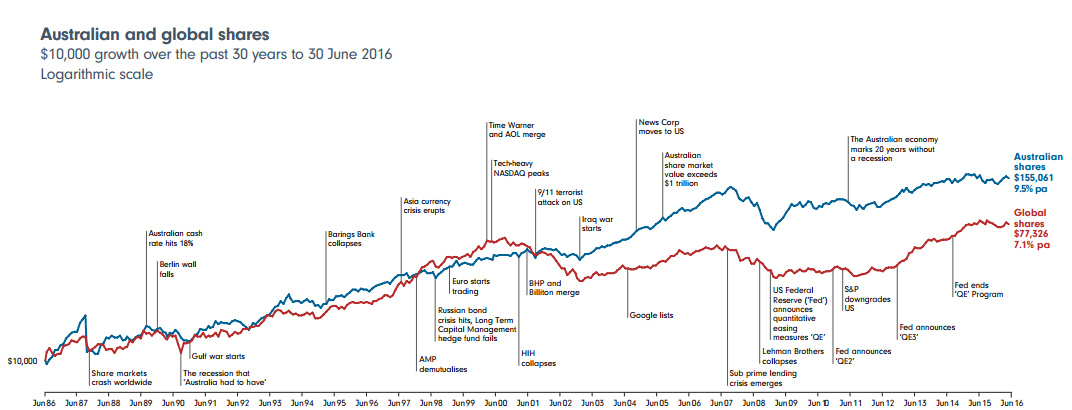
Investing can be tricky at times and during times of market volatility it is useful to take the long view. The 15-year extract above (Shown on a compressed Logarithmic scale)- from Fidelity – indicates what would happen to a $10 000 investment over 30 years in index funds in various markets. For Australian shares the average yearly return is 8.5% over 30 years – but there were some boom times over this time frame. Over a shorter period, Canstar reports a 10-year average return for the Australian Index of 5.5% compared to the, admittedly risk free, cash option of 3.1% over 10 years.

Particularly in these times of low bond and cash yields, if you can accept the volatility of the share market, be willing to live with the occasional investment mistake and have a diverse list of well-managed growing companies in your portfolio – take a deep breath and you will be OK!


Not Index Funds Again … This is Boring!

boreddogThis site spends a bit of time talking about index funds, here and here. As well as the blog, the Slack Investor site hosts pages following the ASX Index, US Index and UK Index. This is because Slack Investor likes, and is invested in, these type of funds. Each page is dedicated to a rules-based method of following these type of funds in a (mostly!) profitable manner …  and, in the Slack Investor tradition, a minimal amount of energy needs to be spent on these investments.

The astute reader will peruse my portfolio page and ask the question

Why does Slack Investor keep going on about these funds when only ~4% of his portfolio is invested in them?

The explanation is that Slack Investor started out 100% in Index funds … and, with some experience started trading in individual shares. I currently have a mixture of both. Index funds are a great place to start your journey into share investment.

There are some eloquent arguments against using the broad index funds as an investment tool. Montgomery maintains the theme “why fill the saddlebags with bad companies!” in this article.

However, despite these funds labelled as “dumb investing” by some, Index funds become more popular each year and have some solid support in the investing community. Slack Investor has developed a simple rules-based method for (usually!) profitable trading in index funds that only requires monthly monitoring. At the end of each month, I will look at the monthly chart of each followed index on Incredible Charts and make one of three decisions – buy, sell, or move my stop loss.

The simplicity of this approach is appealing for its slackness!

Details of this method will be eventually posted on the index pages – Not because I’m secretive, … just because I’m a little slack … and I think it will make an interesting future post … but for now, monthly decision points will be posted as soon as they are made.

This “index trading” method is different to how individual companies are traded by Slack Investor. There are greater risks involved in trading just a few individual companies … but the potential rewards are also much greater! One of the few advantages of being in the investment game a long time is having enough capital to have positions in at least 20 companies … this limits “individual company” risk as each company is just a small fraction of my total portfolio.

Slack Investor is currently enjoying the decisions associated with trading individual companies … even though a bit of effort goes into researching the companies – and they require more monitoring (work!). I am rational enough to know that there will be a time where this extra work will lose its appeal … and then I will revert back to index investing … “dumb” perhaps … but hopefully still profitable.